Holly D. Landez ePortfolio
A Collection of My Work in edTech

Digital Citizenship Reflections
Culminating Project
Reflections
This class has provided me with a wide range of insight in the topics of digital citizenship. With the availability of ubiquitous technology and the growth of the internet has progressed across the past 30 years, we have developed the need to transform our perception of what it means to be a good citizen. Now it is the responsibility of all involved in raising students to help them develop smart and responsible digital citizenship skills as well. This includes:
- Parents
- Teachers
- school administrators
- community leaders
Generation Z, that is students born between 1997 and now, have been born into a world of accessible technology. According to Pew Research Center, ninety-seven percent of teens use social media. They do not exactly separate the real world and the digital world. Therefore, it is logical to include digital citizenship skills in most areas of their education and upbringing. Just as we frequently remind students how to properly conduct themselves in various scenarios (classroom, assembly, restaurants), we should remind them of how to responsibly conduct themselves online. This course has helped strengthen my skills in that area.
I believe that my biggest accomplishment and best work in this course is the culminating project designed in Book Creator that defines each of Mark Ribble’s 9 Elements of Digital Citizenship. It is a tool that school leaders can use to share with teachers and parents which includes resources associated with each element. The mantra present on each page of the book is, “How Can We Do Better?” I chose this mantra because even though digital citizenship education is not a new concept, we must constantly strive to improve the knowledge and skills we impart to students. As technology develops and changes, the challenges for digital citizenship education increases. According to enough.org and DigitalTrends.com, there has been a 70% increase in cyberbullying in recent months.
We must ask ourselves how we can do better at preparing students for positively impacting their digital world. I arrived at this question after watching the 2020 Netflix documentary The Social Dilemma. I don’t necessarily agree with every dire message portrayed in the film, that all social media platforms are driven by greed and disregard the mental health and wellness of users. I do agree that social media has changed the landscape of society. I also agree with Jaron Lanier, computer philosophy writer and a founder of the field of virtual reality, who says at the end of the documentary, “We can do better.”
One challenge I did face was digesting the amount of content in the course that we needed to digest. Although, I do also consider that a strength of the course. The concepts around Digital Citizenship are rich and require more than five weeks to master.
The most meaningful thing that I learned in the course was to persist in my leadership role of emphasizing the need for richer digital citizenship education. In many districts, it ranks low on the list of educational priorities, particularly now as student and teachers are facing so many learning gaps because of the pandemic. Some districts merely provide a technology acceptable use policy, a list of things not to do. In my opinion a more positive and effective approach would be to weave digital citizenship education into regular instruction, providing students with strategies for being a good digital citizen. That also happens to my favorite thing of the course, to make it my mission as a Director of Digital Learning to lead my new district in evolving their implementation of digital citizenship instruction.
References:
- A Netflix original documentary. The Social Dilemma. (2021, December 15). Retrieved December 16, 2021, from https://www.thesocialdilemma.com/
- Pew Charitable Trust. (2019, May 10). Generation Z. Living Facts. Retrieved December 16, 2021, from https://www.livingfacts.org/en/articles/2020/generation-z?utm_campaign=adwords_sustained&utm_source=adwords&utm_medium=paid&utm_content=genz&utm_term=ad2&gclid=Cj0KCQiAzfuNBhCGARIsAD1nu-_4dBBWIzRt3dygGrfVToIqEhEhYtwWli9EQ3xrNofPlXFCd5M3BMQaAls5EALw_wcB
- Wikimedia Foundation. (2021, November 28). Jaron Lanier. Wikipedia. Retrieved December 16, 2021, from https://en.wikipedia.org/wiki/Jaron_Lanier
Image Credits:
People illustrations by Storyset

Cyberbullying
Week 4 of our EDLD 5316 Digital Citizenship course has been rich with learning opportunities! This week we:
- Engaged in discussion posts
- Reviewed cyberbullying case studies
- Read rich material and viewed a variety of videos
- Wrote a reflection journal
- Located additional resources
- Took a quiz (I got a 95!)
- Continued work on our culminating project
Case Study 1 – Patrick Halligan
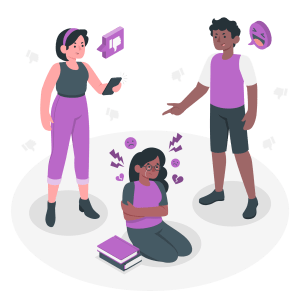
The tragic case of Ryan Halligan, who ended his life after enduring multiple forms of online bullying by his peers, is one that should never be repeated. Sadly, Ryan is not alone, and these types of situations have occurred all over our nation. Some examples are shared here, on Hidden Kids. It is the responsibility of all involved in raising youth to develop strategies and solutions for combatting cyberbullying. This is noted in a Gifted Child article by Dr. Del Siegle, “Parents and educators play an important role in helping young people understand the consequences of poor decisions in a digital age where favorable, as well as unfavorable, text and images spread exponentially.”
Ryan was the victim of several forms of cyberbullying including:
- Denigration: “Dissing” someone online. Sending or posting gossip or rumors about a person to damage his or her reputation or friendships.
- Outing: Sharing someone’s secrets or embarrassing information or images online.
- Trickery: Talking someone into revealing secrets or embarrassing information or images online. (Siegle, 2010).
These actions contributed to Ryan’s feelings of inadequacy, and depression. As he did not report the cyberbullying to his parents, school staff, or other trusted adult there was not a positive resolution to the situation. However, Ryan’s father is now able to make a positive impact on students, parents, and school staff by sharing his website which includes resources for preventing cyberbullying. Additionally, he visits schools to share Ryan’s experiences and advises students, parents, and school staff on steps to take when cyberbullying begins to rear its ugly head. Additionally, Ryan’s case contributed to the 2004 Vermont Act 117; 16 V.S.A. § 11(a)(32); An Act was enabled in memory of Ryan Patrick Halligan who was severely bullied electronically. The penalty is to have schools develop a plan to notify parents of bullying along with the victim and expulsion may be a consequence.
Although the offenders may not have received discipline in school for their behavior, they likely endured some psychological repercussions. If similar bullying occurs in Vermont schools now, they have an obligation to share that with parents and deliver a consequence.
As a school technology leader, I would take several steps to minimize cyberbullying:
- I would advocate for and implement frequent communication with students, parents, and school staff information about cyberbullying. It is essential to humanize these topics and include true stories such as Ryan’s.
- I would ensure that our school district had superior content monitoring and filtration software on the network and on devices to ensure that such activities were not occurring on the school district network or school-issued devices.
- I would encourage school leaders to make bully reporting safe so that students do not have a fear of social repercussions when they report cyberbullying.
- I would do my absolute best to contribute to and help develop positive school climate.
In this talk at George Mason University, Sameer Hinduja, the author of Bullying Beyond the Schoolyard, states that students in schools who perceive a more negative school climate, report more cases of cyberbullying. He goes on to discuss positive social norming, in which school staff, can create a ripple effect of positive school climate, rather than a negative climate. It is the moral obligation of school leaders to be observant and alert to potential bullying and cyberbullying and consciously take steps to build positive school climate so that students are able to put their efforts and energy into building each other up rather than creating painful and dangerous scenarios.
Case Study 2 – Kylie Kenney
Although Kylie Kenney’s situation is similar to Ryan’s in many ways, it has a happier ending. When Kyle’s classmates created the website called “Kill Kylie Incorporated” and then sent out messages pretending to be her, they were engaged in at least two forms of cyberbullying:
- Denigration: “Dissing” someone online. Sending or posting gossip or rumors about a person to damage his or her reputation or friendships.
- Impersonation: Pretending to be someone else and sending or posting material to get that person in trouble or danger or to damage that person’s reputation or friendships.
According to the Deseret News article, the two students responsible for the online bullying were eventually suspended. Additionally, the police had to be involved because their bullying included death threats. It is likely that until then, the students that did not know Kylie very well naively thought that what they were doing was harmless and that they would not be caught. After this situation, Kylie accompanied Utah Attorney General Mark Shurtleff to speak to the National Press Club in Washington, D.C. to shine a light on the need for legislation regarding cyberbullying. Since then, Utah state law includes additional regulations regarding cyberbullying.
A s school technology leader, I would take the same stance as noted previously in the case of Ryan Halligan:
- Training students, parents & staff frequently
- Utilize content monitoring & filtration on the network & devices
- Ensure safe (potentially anonymous) bully reporting
- Advocate for and encourage positive school climate.
Hopefully each of these steps would have a positive effect to reduce the occurrences of cyberbullying.
Reflections & Resources
For our discussion posts for this week, we viewed Monica Lewinsky’s TED Talk, The Price of Shame.
I remember very vividly when this scandal with Monica Lewinsky and Bill Clinton occurred. It seemed like the story was everywhere! On late night TV shows, the news, tabloids and more. Back then it seemed overwhelming and shocking, and Monica Lewinsky was the one every person blamed for the scandal.
The story that Monica described was painful, as was the story of Tyler Clementi that she shared, who took his life after experiencing online bullying. Her story could have been exponentially more painful if it had occurred now, when social media is in constant use by millions of people. Can you imagine the level of pain she would have had to endure while reading comments of thoughtless people hiding behind a computer or smart phone screen?
Monica very eloquently reminded the audience that we are making progress and heading in the right direction, and that we should reinforce empathy and compassion to ease the shame of mistakes people make. However, positive reinforcement is not quite enough. In Texas we have David’s Law, which is named after a boy that took his own life after he was relentlessly bullied online.
“This law allows schools to combat and prevent cyberbullying by empowering them to investigate and address off-campus cyber-assisted bullying if it materially affects the school environment. “
I had the opportunity to hear David’s father speak and tell his story at a high school. That was incredibly impactful and made an impression on the students! This images shows the positive impact that David’s law is having in the issues associated with bullying in Texas schools.
Additionally, we viewed a video featuring poet Shane Koyczan which was moving and provided an opportunity to consider how the bullied feel. Models such as this, and well as the cases of Ryan, Kylie and David should be shared with students to remind them to be empathetic and compassionate, rather that working to build shame in others.
We also engaged in reading some very meaningful content. What I found helpful and engage was the book called Bullying Beyond the Schoolyard: Preventing and Responding to Cyberbullying by Sameer Hinduja and Justin Patchin. I have not read the entire book yet, but I especially enjoy the scenarios outlined in the book. Of course accessing one resource can lead to YouTube rabbit hole, which is what happened to me. So I also came across multiple videos featuring the authors. I especially enjoyed these two featuring Sameer Hinduja presenting at George Mason University and at the World Anti-Bullying Forum. In both videos he shares his definition of cyberbullying as “willful and repeated harm inflicted through the use of computers, cell phones, and other electronic devices” and shares current (for the time) statistics about cyberbullying, as will as contributing factors to and the effects of cyberbullying.
One of the most useful sites I encountered was https://cyberbullying.org/ which provides information and resources to define and prevent cyberbullying. Additionally, it compares and details the laws regarding cyberbullying in each state of America.
Reviewing the case studies of Ryan and Kylie were helpful because it reminded me that each case is different, and can quickly become dangerous if not bought to the attention of trusted and engaged adults. This led me to examine the current state of cyberbullying. Sadly, with the pandemic, reports and statistics are not terribly promising. Security.org reports that due to an increase in social media use as a result of COVID-19 lockdowns, cyberbullying was on the rise, with twenty-one percent of students reporting that they have been cyberbullied. With the latest statistics, Broadbandsearch reports that 42% of cyberbullying occurs on Instagram.
Just as the pandemic has set back teaching and learning, and created instructional gaps, it has also set the stage for an uptick of cyberbullying. Just as I believe that our students will continue to make learning gains, I choose to believe that as time goes by and educational communities are rebuilt, positive school climates will be able to make a shift once again toward minimizing cyberbullying. Our students’ lives depend on it!
https://www.stopbullying.gov/cyberbullying/establishing-rules – Just in time tips for parents about setting limits and boundaries around screen time and digital wellness.
Cyberbullying Warning Signs – An extremely valuable resource from Cyberbullying.com to share with parents
https://enough.org/stats_cyberbullying – Recent statistics about cyberbullying in the United States
References:
- Bullying laws in Utah. Cyberbullying Research Center. (2021, February 15). Retrieved December 10, 2021, from https://cyberbullying.org/bullying-laws/utah.
- Bullying laws in Vermont. Cyberbullying Research Center. (n.d.). Retrieved December 10, 2021, from https://cyberbullying.org/bullying-laws/vermont.
- Hinduja, S., & Patchin, J. W. (2015). Bullying beyond the schoolyard: Preventing and responding to cyperbullying. (2nd ed.). Thousand Oaks, CA: Corwin.
- “Legislation.” David’s Legacy Foundation, 18 Nov. 2021, https://www.davidslegacy.org/programs/legislation/.
- Siegle, D.(2010). Cyberbullying and sexting: Technology abuses of the 21st century. Gifted Child Today, 32(2), 14-16, 65. Siegle_Cyberbullying_and_Sexting.pdf
- Securely. (2019, December 4). The 10 types of cyberbullying. Blog. Retrieved December 10, 2021, from https://blog.securly.com/2018/10/04/the-10-types-of-cyberbullying/.
- Stories. Hidden Kids. (n.d.). Retrieved December 10, 2021, from https://hiddenkidz.weebly.com/stories.html.
- Struglinski, S. (2006, August 18). Schoolyard bullying has gone high-tech. Deseret News. Retrieved December 10, 2021, from https://www.deseret.com/2006/8/18/19969197/schoolyard-bullying-has-gone-high-tech.
- The Center for Evidence-Based Crime Policy. (2015). Sameer Hinduja – Preventing Cyber-Bullying through School Climate and Youth Kindness Initiatives. YouTube. Retrieved December 10, 2021, from https://youtu.be/2kqHk041d9A?t=312.
- World Anti-Bullying Forum. (2012, February 12). Sameer Hinduja on cyber-bullying at WABF 2017 . YouTube. Retrieved December 10, 2021, from https://www.youtube.com/watch?v=-A2FINYsKvM.
Image Credits:
Copyright
Copyright Case Study 1 – Terry
In this case study, we were asked to analyze whether or not Terry, a high school teacher, is ethically and legally permitted to use these resources and artifacts for instructional material under current copyright regulations. The notes in the attached document are my perceptions based on the course materials that have been provided in EDLD 5316 Digital Citizenship at Lamar University by Dr. Frederico Padovan, as well as my own additional research.
Generally, most of the content that Terry would hope to use would be allowable under Fair Use Guidelines. The four factors of Fair Use for published and unpublished works include:
- the purpose and character of the use, including whether such use is of a commercial nature or is for nonprofit educational purposes;
- the nature of the copyrighted work;
- the amount and substantiality of the portion used in relation to the copyrighted work as a whole; and
- the effect of the use upon the potential market for or value of the copyrighted work.
In this imaginary scenario, as the district Chief Technology Officer, I would take several steps to ensure that the teachers, staff and students were using good judgment in sharing the materials digitally. This includes materials they access from print and digital resources, as well as artifacts they create. Primarily, I would ensure that annual training regarding copyright and fair use guidelines were available to staff and students. It is a common misconception that fair use implies that teachers are able to share practically anything if they are using it for educational purposes. This is not completely true. In order to protect the intellectual property rights of creators and the district population, and to raise ethical digital citizens, frequent reminders to properly credit creators is essential. This is the job of all involved; librarians, counselors, teachers, administrative and technology staff.
Campus librarians are generally the go-to copyright experts at a school. Therefore, they are an excellent resource if a there is a question about whether or not is is allowable to use certain content for instruction. Librarians and administrative staff should model the appropriate behavior for good copyright habits, which include:
- Consulting US copyright guidelines, such as those found on the Copyright Office website.
- Consulting the creative source of the material in question. For example, I have include on the attached document links to sharing guidelines web pages for PBS, NASA, and New York Times.
- Citing resources whenever possible, and emphasizing that habit among students.
Copyright Case Study 2 – Mr. Rosebud
The case study of Mr. Rosebud and Mr. Cameron’s books, still images, supplemental material, and student videos is quite complicated with much to consider. There are many players involved in this case, including the two authors Mr. Rosebud and Mr. Cameron, the potential book publisher, the nearby college, the school district, and the students. If I were the chief technology officer at Mr. Rosebud school, I would take the most informed steps to protect the interest of Mr. Cameron, Mr. Rosebud, the school district, and the students. An obvious first step is to ensure that all of the parties involved have annual required training regarding copyright. In my opinion, the parties that need to be most protected are the students.
As adults, the co-authors Mr. Rosebud and Mr. Cameron should take the steps that they need to protect themselves. This includes any agreement that they may have with the publishing company. If they have an agreement with the publishing company, they can potentially hand over copyright ownership and royalty rights. Before they have any agreement with the publishing company, they are entitled equally to any royalties earned from the book. The co-authors of the book should register it to protect them selves and in case they ever have the need to file a case of copyright infringement.
Regarding the film stills that Mr. Cameron and Mr. Rosebud hope to use in their book, if they use only a small portion of film stills, then it is likely covered under fair use. This is because of the fair use factors regarding the amount and substantiality of the portion used in relation to the copyrighted work as a whole; and the effect of the use upon the potential market for or value of the copyrighted work. As the stills should fall under fair use, there is not a requirement, but Mr. Cameron and Mr. Rosebud should continue to try and get permission to use the stills and attribute credit in their book.
According to the American library association, the teach act does not authorize the distribution of books and articles. The teach act refers to performances and displaying works. The two most important facts about the book chapters distributed to students that will impact a fair use analysis are:
3) the amount and substantiality of the portion used in relation to the copyrighted work as a whole; and
(4) the effect of the use upon the potential market for or value of the copyrighted work.
Reflections
This week in EDLD 5316, Copyrights and Copywrongs, we covered so much content! It is safe to say that copyright law is very complicated and should be taken on a case-by-case basis. I would imagine that the demand for copyright lawyers is increasing as the need for copyright registrations increase. As the ability to publish digital content increases and technology changes, so too must the rules change.
A few of the topics we reviewed this week were:
In our discussion post we reviewed the Hudson white paper and whether the US copyright office should continue to be under the auspice of the library of Congress.
After reviewing the Hudson Institute white paper, I am inclined to agree that the Copyright Office should be separated from the Library of Congress. It appears that the Copyright Office has been underfunded and overlooked in recent years, when the need for copyright is increasing. The reasons for the Copyright Office to be dependent on the Library of Congress are now outdated, as the scope of copyright includes far more digital material. As content a now able to be created by millions of people in far less time, the requests for copyright (particularly over digital material) must be staggering.
If the Copyright Office was its own entity, then it would have its own budget to allow for a faster, more effective digitized process. It does appear that in recent years, the Copyright Office is moving toward modernization. They currently have an online instant registration and claim filing system. It is interesting to read changes in the Copyright Office that have taken place most recently, throughout the pandemic. While they are still under the auspices of the Library of Congress, they do appear to be modernizing.
Additionally, we went over some definitions of copyright terms.
- Plagiarism is defined as the act of using another person’s words or ideas without giving credit to that person. An example of plagiarism would be if I read a research article about STEM activities in libraries and copied sentences directly into a blog post without changing the language or using quotes to indicate that the words and ideas were not my own.
- Copyright infringement occurs when a copyrighted work is reproduced, distributed, performed, publicly displayed, or made into a derivative work without the permission of the copyright owner. An example of Copyright infringement would be if I downloaded material from Monica Burns’ Easy EdTech Club, a monthly subscription service, and made the materials available to teachers in my Schoology course
- Attribution is an explicit or formal acknowledgment of ownership or authorship. Examples of attribution would be our APA citations listed at the bottom of our discussion or blog posts and mentioning the name of an author when we are sharing their ideas.
- Transformation is using a work of art, literature, music or video and changing it in a creative or surprising way. Parodies like Weird Al Yankovics’ Eat It are considered transformative because the modification of the original song it parodies has completely different lyrics.
In two case studies we reflected deeply upon fair use, public domain, copyright law, and Creative Commons.
The four factors of fair use include:
- the purpose and character of the use, including whether such use is of a commercial nature or is for nonprofit educational purposes;
- the nature of the copyrighted work;
- the amount and substantiality of the portion used in relation to the copyrighted work as a whole; and
- the effect of the use upon the potential market for or value of the copyrighted work.
Also, we had a quiz which covered multiple copyright scenarios. I earned a 96 on the quiz after lots of research!
The materials that I found most effective were the multiple videos that we accessed. I have them all listed here in a YouTube playlist.
Also, this Coursera course on copyright for Librarians and Educators was especially useful! It included videos, supplemental resources, scenarios, and quizzes.
As I progress in my career with my rich newfound knowledge of the intricacies of copyright, fair use, creative commons and public domain, I feel confident each case needs to be carefully considered individually. The best we can do is train our educators and students to give credit where it is due, cite sources, and seek permission when using the content of another creator.

Additional Resources
Columbia University Libraries Copyright Advisory Services Fair Use page – This page concisely outlines the four factors of fair use and includes a very handy fair use checklist.
The Educator’s Guide to Copyright, Fair Use, and Creative Commons – This website explains copyright concerns for educators in simple language
TEACH Act Checklist – Use this handy checklist to see if you are ready to use the TEACH Act
References:
- Circular 14 Copyright in Derivative Works and Compilations. US Copyright Office. (2020, July). Retrieved December 2, 2021, from https://www.copyright.gov/circs/circ14.pdf.
- Circular 30 works made for Hire. US Copyright Office. (2021, March). Retrieved December 5, 2021, from https://www.copyright.gov/circs/circ30.pdf.
- Copyright for libraries: Teach act. LibGuides. (n.d.). Retrieved December 2, 2021, from https://libguides.ala.org/copyright/teachact.
- Copyright for using movies in the classroom. Teach with Movies. (n.d.). Retrieved December 3, 2021, from https://teachwithmovies.org/copyright-for-using-movies-in-the-classroom/.
- Creativity, Copyright and Fair Use. (2020). Common Sense Education. Retrieved December 2, 2021, from https://www.commonsense.org/education/videos/creativity-copyright-and-fair-use.
- Cul – Main Content. Fair Use | Columbia University Libraries. (n.d.). Retrieved December 2, 2021, from https://copyright.columbia.edu/basics/fair-use.html.
- Daines, G. (2015, March 11). Media usage guidelines. NASA. Retrieved December 2, 2021, from https://www.nasa.gov/multimedia/guidelines/index.html.
- Intellectual property in schools October 2020 – tasb.org. Texas Association of School Boards. (2020, October). Retrieved December 2, 2021, from https://www.tasb.org/services/legal-services/tasb-school-law-esource/business/documents/intellectual-property-in-schools.pdf.
- Linking – help. (n.d.). Retrieved December 2, 2021, from https://help.nytimes.com/hc/en-us/articles/115014893268-Linking.
- Obtaining and using times content – help. (n.d.). Retrieved December 2, 2021, from https://help.nytimes.com/hc/en-us/articles/115014891408-Obtaining-and-using-Times-content.
- Projects, C. to W. (2016, November 9). On the Origin of Species (1859). Wikisource, the free online library. Retrieved December 2, 2021, from https://en.wikisource.org/wiki/On_the_Origin_of_Species_(1859).
- Public Broadcasting Service. (2018, May 7). I am a teacher and I want to hold a screening of a PBS show for my students. can I do that? PBS. Retrieved December 5, 2021, from https://help.pbs.org/support/solutions/articles/5000673774-i-am-a-teacher-and-i-want-to-hold-a-screening-of-a-pbs-show-for-my-students-can-i-do-that-#:~:text=Using%20PBS%20Content-,I%20am%20a%20teacher%20and%20I%20want%20to%20hold%20a,PBS%20show%20for%20my%20students.&text=Under%20the%20Fair%20Use%20Guidelines,10%20days%20in%20the%20classroom.
- Quilter, L., & Bailey, L. (2014, February 9). Copyright for educators (US). P2PU. Retrieved December 3, 2021, from https://courses.p2pu.org/en/courses/1275/content/2883/.
- Smith, K., Macklin, L., & Gilliland, A. (2015). Copyright for educators and librarian. Retrieved from http://coursera.org/learn/copyright-for-education, Creative Commons Attribution/Share Alike license (CC BY SA)
- Swank Motion Pictures. (n.d.). Movie licensing USA: Copyright: Swank motion pictures. Movie Licensing USA: Copyright . Retrieved December 2, 2021, from https://www.swank.com/k-12-schools/copyright.
Image Credits:
Net Neutrality & Digital Tattoo
Two Digital Citizenship Topics in One Post
Net Neutrality
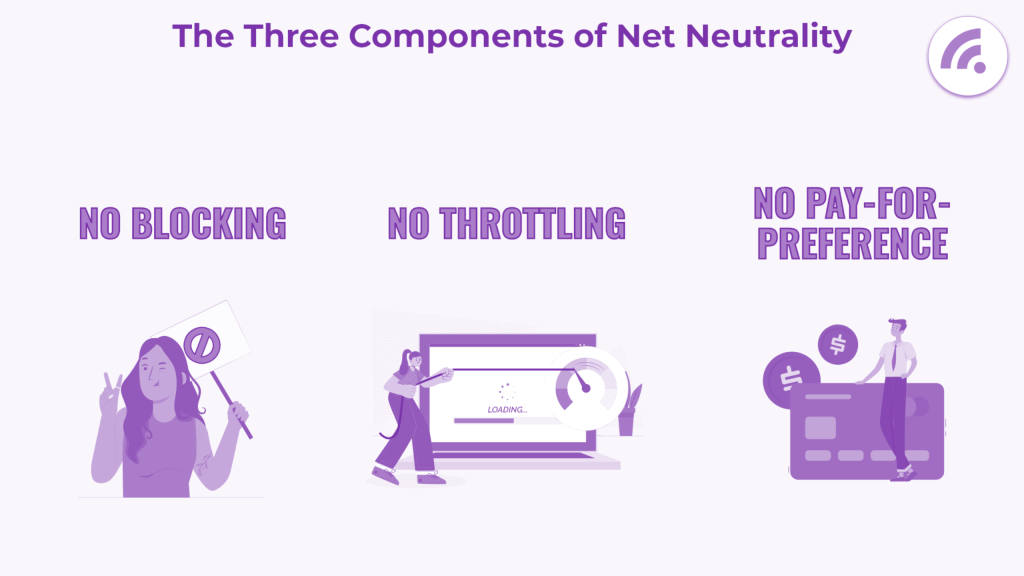
Net neutrality, the concept that the internet is open to users regardless of legal content that they choose to access, without being blocked, throttled, or required to pay additional fees has implications for education. According to Dr. Amy McGinn of Loyola University in her 2017 blog post, “Net neutrality is the principle that all data on the internet should be treated equally by Internet Service Providers (ISPs).” Further, when net neutrality is in place, ISPs are not able to slow access or charge extra based on content that is being accessed, such as video streaming services.
The lack of net neutrality guidelines can impact education as we consider the need to provide equitable access to content and learning for all students, in all communities. In a 2017 NPR interview, Richard Culatta, the current president of ISTE, the International Society for Technology in Education, expressed concern about the deregulation of net neutrality. He provided an example from a Chattanooga, Tennessee school where students were able to use the internet to access scanning electron microscopes. As actual electron microscopes are very expensive, the students would not normally have had the opportunity experiment with them. However, they were able to access one from the University of Southern California digitally. If their high-speed internet access was throttled, this would affect their equitable access to the learning opportunity of accessing the scanning electron microscope, among other opportunities.
Part of what is exciting about technology in education is that internet access feels like the great equalizer, bringing tools and access to applications and opportunities to students digitally. There is concern that without enforceable net neutrality guidelines, that equity is threatened. All students deserve equitable access to legal instructional content to have equitable learning opportunities.
In the past few years, net neutrality has been in a state of political ping pong as the regulation has changed with different presidential administrations. Internet service providers and corporations are against net neutrality in the name of innovation. Additionally, there is controversy over whether or not states are able to enforce their own net neutrality regulations, as Drew Clark of Broadband Breakfast suggested in a May 2021, video stream.
The story of net neutrality and its impact on citizens, education and internet service providers will certainly continue in the United States, as well as other countries. The best that we can do as educators is to continue to provide enriching digital learning opportunities for students.
My Digital Footprint and Tattoo
Our digital footprint, or digital tattoo is our digital trail, or the data that exists as we interact with various online applications. We can use the terms digital footprint and digital tattoo interchangeably, as the mean the same things. However, when discussing this with students, I prefer using the term digital tattoo because of its suggestion of permanence. Children and teenagers do not generally have a concept of the potential permanency of their actions both in the real and the online worlds because of their naivety and lack of experience. As educators and parents, it is our responsibility to frequently remind them that their online actions can have future implications. Additionally, we have the obligation to be aware of the digital footprint we may be forming on behalf of our children. The 2008 Youth and Media video Digital Dossier perfectly explains the concept of the breadth and permanence of our digital tattoo.
One very effective activity for illustrating the concept of the digital tattoo is to simply have participants do an internet search of their name on Google, Yahoo or Bing. It can be very revealing, showing the good, the bad and the ugly. Of course, the more active the student is online, the more there is to find. This can be particularly true if you have a name that is not very common.
When I searched myself this week, I was surprised by a few things. Generally, my online presence is a positive one, and I make a concerted effort to maintain that. I am active on multiple social media platforms including LinkedIn, Facebook, Twitter, Instagram, and Pinterest. My search revealed my ePortfolio, my association with Killeen ISD, and a couple of platforms that I have stopped using long, ago. For example, I did not realize that set of lists (along with those of my colleagues) were public on Spelling City. Is an early adopter of various digital tools for many years, I have accounts on multiple platforms that I have tried and abandoned. A few of these are bulb, Clubhouse and classroom 2.0.
One of the creepiest places to find your personal information or on sites like beenverified.com and govsalaries.com. While much of the info is accurate, some is not as it is cultivated by automated web crawlers. Many times, these types of sites are created for money-making. Establishments are designed specifically for selling your information that is readily available online because it was posted by you, or is in public records such births, marriage, and death.
The thing that surprised me the most was to find articles that I have pinned on Pinterest as well as comments made on Facebook or Twitter on the posts of others. This is where students can get tripped up for sure! While I would give myself a score of 4 – advanced for the positivity aspect, I would give myself a lower score regarding the sheer abundance of my personal information that is available. I certainly need to work on that!
“Everything you do now ends up in your permanent record. The best plan is to overload Google with a long tail
Seth Godin
Reflections
This week in our EDLD 5316 Digital Citizenship course has been rich in experiences and learning opportunities. The concept of Digital Citizenship is broad and has so many interwoven elements to explore. This week we have delved into the concepts of the digital footprint (tattoo) and net neutrality as well as started work on the culminating project.
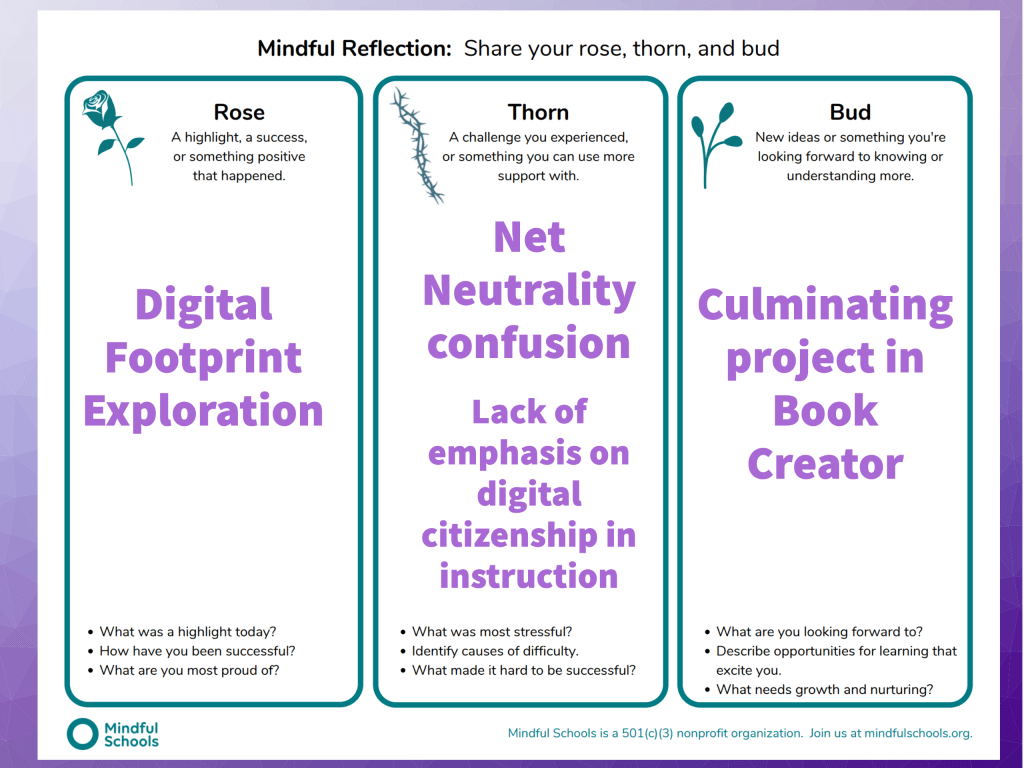
Mindful Schools outlines a fun and effective reflection activity called Rose, Thorn and Bud as a way of attaching thoughts and feelings to learning experiences. I will frame this reflection with that method.
The rose for this week would be the opportunity to explore our own digital footprint in a Google or Yahoo search of our names. I enjoyed that and caught some areas where I need to improve!
Something I had not considered before is that our students of today are experiencing the fact that their digital footprint is created even before they are born. As soon as a parent post an ultrasound picture with the name and expected due date of their child, then the details of their life are beginning to become public. Many parents are simply proud of their children and want to share every funny moment, frustration, and milestone. If we are sharing these before our children can have a voice, then we are doing them a disservice in prematurely contributing to their digital tattoo unnecessarily. Although I believed that I was a not a person who overshared, when my daughter was about 10, she pointed out that I had a large amount of YouTube videos of our family adventures. The privacy settings were set to public. Some of her school friends discovered the videos and teased her. I very quickly changed the settings to private and asked permission before posting images of either one of my children in online environments.
Another tool that my digitally inclined friends and I used excessively was called Four Square. We posted images of places we visited along with hints and recommendations. The app had a competitive element to it, as the person that posted them most from a location became the mayor. I never realized the safety implications until I came across the name of the app in an article about online safety. I stopped using the app, and promptly forgot about it. But guess what? The posts are still there, like a tattoo! There is nothing embarrassing or weird posted there, aside from clear patterns of locations we frequented at that time.
Also, I previously had not considered that in addition to the digital footprint that we can control by our social media posts and sharing in online spaces, there are thousands of digital footprints that we do not have control over. Those are the ones built by our digital interactions with various entities in our daily lives. Banking, map locations, purchases online, doctor visits and more. It is endless. Then if we factor in our conversations that can be overheard by digital assistants like Google Home, Alexa and Siri, it can quickly get overwhelming.
My thorn for this week has two layers: the politicized controversy over net neutrality and the lack of emphasis in education placed on digital citizenship. The issue and lack of solid regulations of net neutrality is a thorn for me solely because I feel uncomfortable when in a state of limbo. The fact that the regulations change with each presidential administration is confusing at best. Also, I feel very strongly that equitable access to educational resources should not be controlled by corporations. In a 2014 Forbes article, Josh Steimle suggests that net neutrality could potentially lead the government to install “hardware and software at critical points to monitor Internet traffic.” Well, if that means safety and equity, then I am okay with that. He also points out that this could eventually lead to a “mismanaged public monopoly.” That would not be good at all.
The other layer of my thorn is the lack of emphasis in education placed on digital citizenship. I can completely understand why it has taken a back seat, as it is an issue of time. However, I think the future, safety and mental health of our students will be negatively affected if we do not find ways to incorporate digital citizenship into daily conversations with students. It should be naturally woven into instruction, rather than separate lessons. One way for this occur is if we raise awareness with teachers, so that it becomes a natural part of their conversations with students. Personally, I would like for each on of our teachers explore the resources of Common Sense Education, and earn their Common Sense Educator Badge. As an ambassador, I have been striving to achieve that!
The bud for this week is the culminating project. I have so many ideas swirling in my head as there is so much content to cover. I have determined that I will make a book in Book Creator. It is such a versatile tool that I can creatively incorporate multimedia as well as share a huge variety of resources.
The keys for successfully sharing the concepts of digital footprint and net neutrality as well as the other elements of digital citizenship are to explore the wealth of resources without becoming overwhelmed and to make it part of everyday conversation.
For cyber-security and information about keeping your passwords safe, click here.
References:
- Broadband Breakfast. (2021). May 12, 2021 – Ask Us About Net Neutrality. YouTube. Retrieved November 20, 2021, from https://youtu.be/v4FA6b_mk8Q.
- Digital Dossier. (2008). YouTube. Retrieved November 20, 2021, from https://youtu.be/79IYZVYIVLA.
- Gonzalez, A. (2021, February 24). A mindful way to reflect: Rose, Thorn, and bud. Mindful Schools. Retrieved November 20, 2021, from https://www.mindfulschools.org/inspiration/mindful-reflection/.
- Lucacept – intercepting the web. (2017, May 7). Retrieved November 26, 2021, from https://jennyluca.com/.
- McGinn, A. L. (2017). Why we should care about net neutrality. School of Education Blog. Retrieved November 20, 2021, from https://www.loyola.edu/school-education/blog/2017/why-we-should-care-about-net-neutrality.
- NPR. (2017, December 12). How repealing net neutrality could affect schools’ internet access. NPR. Retrieved November 24, 2021, from https://www.npr.org/2017/12/12/570248510/how-repealing-net-neutrality-could-affect-schools-internet-access.
- Steimle, J. (2016, February 2). Am I the only Techie Against Net Neutrality? Forbes. Retrieved November 24, 2021, from https://www.forbes.com/sites/joshsteimle/2014/05/14/am-i-the-only-techie-against-net-neutrality/?sh=7ccdf3970d51.
- The latest on net neutrality – where are we in 2021? BroadbandSearch.net. (2021). Retrieved November 28, 2021, from https://www.broadbandsearch.net/blog/net-neutrality.
- Wikimedia Foundation. (2021, November 2). Foursquare City Guide. Wikipedia. Retrieved November 20, 2021, from https://en.wikipedia.org/wiki/Foursquare_City_Guide.
Nine Elements of Digital Citizenship
What is Digital Citizenship?
The International Society for Technology in Education defines digital citizenship as the rights, responsibilities and opportunities of living, learning and working in an interconnected digital world, and acting in ways that are safe, legal and ethical.
In his book, Digital Citizenship in Schools, Mark Ribble defines digital citizenship as “the norms of appropriate, responsible behavior with regard to technology use.”
In a 2011 ASCD Article, Jason Ohler defines digital citizenship as Character Education for the Digital Age and how digital citizens know the best way to use technology.
DigCitCommit defines digital citizenship as the critical skills comprised of five competencies necessary for the students of today and the leaders to tomorrow to be successful. These competencies are: Inclusive, Informed, Engaged, Balanced and Alert.
After reviewing all of these resources, I have developed my own definition of digital citizenship. I believe that digital citizenship is the critical set of skills someone needs to have to be a productive, educated, safe and effective member of the digital world.
It is our duty as educators and school leaders to instill these beliefs and skills in students so that they are able to contribute to their digital communities in meaningful, and not destructive, ways. Further, as technology changes rapidly, so must our perceptions and definitions of digital citizenship.
“Because technology is becoming ever more accessible, and students are using these technologies more frequently (both in school and out), technology leaders must continually assess and determine their priorities in terms of digital citizenship.”
Mark Ribble, Digital Citizenship in Schools
Resources for Sharing Digital Citizenship Concepts
In order for teachers to be able to effectively share this information with students, they should first engage in professional learning opportunities to gain a sense what digital citizenship is, and why it is important. After the needs of the campus or school have been determined, then a formal or informal plan for developing digital citizenship can be deployed. As teachers learn to recognize the teachable moments that avail themselves to conversations about digital citizenship, students will gain the skills they need.
The resources listed below are just a handful of the plethora of information available to teachers. These can be shared with teachers in formal professional learning opportunities, or in small chunks such as a newsletter entry, quick email message, or social media post. Similarly, teachers can share this information with students as formal lessons, embedded in regular instruction as teachable moments or as messages sent home to parents.

Common Sense – As the quintessential resource for educators and parents to help students gain the knowledge and skills they need to grow into becoming ethical digital citizens, Common Sense maintains a free digital citizenship curriculum for grades K – 12 and hosts reviews of various media products including books, movies and applications.
DigCitCommit – A coalition of organizations dedicated to providing educators with the tools to teach a new definition of digital citizenship
Be Internet Awesome – Google’s digital citizenship program for students which includes a game and full curriculum
Smart Social – This site is home to a frequently updated podcast, along with practical, timely and relevant tips to help students, teachers and parents gain skills to shine online.
Get Safe Online – UK’s leading source of unbiased, factual and easy-to-understand information on online safety
Surfnet Kids – This website of syndicated columnist Barbara Feldman features resources for parents and educators to help kids wisely and safely explore their online world.
Nine Elements of Digital Citizenship
The topic of digital citizenship is a broad one, and it is simpler to discuss when chunked into related ideas and groups. In his book Digital Citizenship in Schools, Mark Ribble outlines nine elements of digital citizenship. If each participant in digital spaces embraces these elements, then we will have a strong community of good digital citizens. The nine elements are further categorized into 3 principles, referred to as REPs:
The nine elements are related in various ways and affect students both in school and outside of school. If the primary goal of the education system is to improve learning outcomes, then perhaps the three elements associated with student learning and academic behavior should be the primary focus for digital citizenship instruction in schools.
Respect Yourself/Respect Others
- Etiquette – The norms and rules of behavior need to be outlined.
- Access – Not all access to digital devices and internet service is equal.
- Law – As technology changes, the need to update laws are necessary.
Educate Yourself/Connect with Others
- Communication – There are so many ways to communicate in the digital world.
- Literacy – The awareness of how to properly use digital devices and applications is essential.
- Commerce – Citizens need to be aware of methods of earning and purchasing online.
Protect Yourself/Protect Others
- Rights & responsibilities – The right to be a citizen in a community comes with responsibilities.
- Health & wellness – Using technology excessively or incorrectly can lead to mental or physical health concerns.
- Security – Citizens must learn methods of protecting themselves and others in online environments.
Student Learning & Academic Behavior
- Digital Literacy
- Digital Communication
- Digital Access
School Environment & Student Behavior
- Digital Security
- Digital Etiquette
- Digital Rights & responsibilities
Student Life Outside the School Environment
- Digital Health & wellness
- Digital Law
- Digital Commerce

In my opinion, the top three of Ribble’s nine elements of digital citizenship are: etiquette, literacy and safety. I chose one from each of the three principles of Respect, Educate and Protect as I believe that they are all related to each other.
Digital Etiquette refers to treating others with respect in online spaces. I am continuously surprised by the unkind comments that I see in social media and in other online spaces. It is disheartening when the unkind posts I see are from parents of our students, or worse, teachers. Each time I see posts with an unkind or argumentative tone, it highlights the need for ongoing education of our students and families. In our district, we have made a conscious effort to introduce the Common Sense curriculum to our librarians, curriculum specialists and campus technologists for at least the past seven years to emphasize the need for skill development in this area.
Digital Literacy is another critical element of digital citizenship because in order to be responsible with something, you must know how to use it. This brings to mind incidents that I have seen of people who accidentally overshare when they post on social media because they are not adept that adjusting privacy settings. It is for that reason that at every given opportunity when I am introducing a digital tool, I encourage the users to find and use whatever built in help section exists in the program. Knowing where to find the information needed to become literate in a program empowers users. Building this habit in teachers will encourage them to pass it on to students.
Digital Safety is one of the most paramount of the elements of digital citizenship. This can mean protecting the personal details of your identity to avoid identity theft which can result in financial ruin. But even more serious is the safety of our children. It is imperative that students are frequently reminded to be mindful of their surroundings and what they share in online communities. Sex trafficking is a rampant problem as the internet can be used to target unsuspecting and vulnerable youth. One tool we have to prevent such tragedies is to educate our students!
Reflections

The nine elements of digital citizenship are critical skills which must be shared with students, school staff and parents. Very often, the online world can feel like the wild, wild west, with outlaws around every corner and dangerous pitfalls to be found. If we are to bring civilization and order to the online environment, we must begin by building competent digital citizens.
Throughout my years as a District Instructional Technologist, I have had some experience dealing with the concepts of digital citizenship. In my role, I have repeatedly shared the need for embedding digital citizenship into our curriculum. In 2019, I had the privilege of leading a Digital Wellness Initiative. At that time, I did not have the concept that wellness was just one part, or one element, of digital citizenship. In that initiative, each of the 54 campuses in our district, sent one to three campus stakeholders to training. These leaders may have been curriculum specialists, counselors, librarians, or campus technologists. In some cases, it was a principal or assistant principal. During the training led by a Common Sense presenter, the campus leaders engaged in a deep learning opportunity centered around digital citizenship concepts. Then they worked together to customize a training plan for their campus teachers and students.
The campus leaders did a great job of cultivating an awareness of these concepts with their staff, students, and parents. Unfortunately, many of these efforts were thwarted by the pandemic. Since then, it has been a struggle to get back on the digital citizenship train for our entire district in a meaningful way. Goals and focuses have shifted. Last year, the goal was to support teachers and students through virtual learning. This year, the main goals are to fill in the learning gaps that have grown because of the pandemic and virtual learning
However, I believe that now more than ever our students, staff, and parents need to be reminded of the elements of digital citizenship. Technology use has proliferated and grown exponentially over the past few years. It will certainly continue to do so, and we will be faced with new opportunities to define digital citizenship further. Consideration of the ethics, norms, and behaviors for what is acceptable digital use go far beyond the classroom walls. Recently in current events, social media entities like Facebook and Instagram have been under scrutiny. A former Facebook employee came forward with concerns over encouraging hate speech, and Instagram affecting the emotional health and body images of young users.
In my own community, there is a current “fair use” divide between my school district and the local newspaper. The district has chosen to no longer share stories with the newspaper amid claims that they used photos taken at school events out of context. Because these types of issues will likely increase, I believe that it is vital to continue educating our students and families in the nine essential elements of digital citizenship and what it means to be a “good” digital citizen.
This week in EDLD 5316, I have been presented with a high volume of content to consider about digital citizenship. Primarily, I learned the fact that we must revisit digital citizenship in a broader way in my school district. To do that purposefully will require some planning.
I appreciate the resource of Mark Ribble’s book digital citizenship in schools. He sets forth practical applications and valuable lessons in three critical areas:
- Guidance for school leaders in assessing the need for digital citizenship
- Providing professional learning opportunities for school staff to learn about the nine elements of digital citizenship.
- Lesson plan and activity ideas for teachers directly connected to the 9 elements of digital citizenship and the ISTE standards.
I will most certainly refer to this book in my future projects to support building a strong community of good digital citizens in my school district!
References:
- Digital Citizenship. (2021, August 24). Common Sense Education. https://www.commonsense.org/education/digital-citizenship.
- Free, online security advice. Get Safe Online. (2021, October 29). Retrieved November 20, 2021, from https://www.getsafeonline.org/.
- Google. (2021). Be internet awesome. Google. Retrieved November 20, 2021, from https://beinternetawesome.withgoogle.com/en_us/educators.
- ISTE standards: Students. ISTE. (n.d.). Retrieved November 22, 2021, from https://www.iste.org/standards/iste-standards-for-students.
- Internet safety 101: Sex trafficking. Internet Safety 101: (n.d.). Retrieved November 19, 2021, from https://internetsafety101.org/trafficking.
- Ochs, J. (2021). Digital Citizenship blog at SmartSocial.com. Smart Social Learn How to Shine Online. Retrieved November 22, 2021, from https://smartsocial.com/blog.
- Ohler, J. (2011, February 1). Character education for the Digital age. ASCD. Retrieved November 22, 2021, from https://www.ascd.org/el/articles/character-education-for-the-digital-age.
- Resources. DigCitCommit. (2021). Retrieved November 20, 2021, from https://digcitcommit.org/resources.
- Ribble, M. (2015). Digital Citizenship in Schools: Nine Elements All Students Should Know (Third ed.). International Society for Technology in Education.
- Surfing the net with kids. Tech Tips ” Surfnetkids. (2021). Retrieved November 22, 2021, from https://www.surfnetkids.com/tech/.
- The Guardian. Retrieved November 19, 2021, from https://www.theguardian.com/technology/2021/oct/25/facebook-whistleblower-frances-haugen-calls-for-urgent-external-regulation.
Image Credits:
Library Learning Hubs – Updated Innovation Plan
It hardly seems possible that an entire year has passed since we began working on our innovation plans in EDLD 5305. While many elements of my original innovation plan to host a library STREAM Camp are the same, I recognized the need to make enhancements. Some adjustments are due to experiences of the past year, and some are due to additional research.
After researching, I have determined to shift my overall Innovation Plan from only being focused on STREAM camp, to supporting the transformation of our district libraries to engaging learning hubs. Professional learning is a critical element of this transformation as librarians are required to provide engaging, innovative activities such as coding, 3D printing and other STEM focused events.
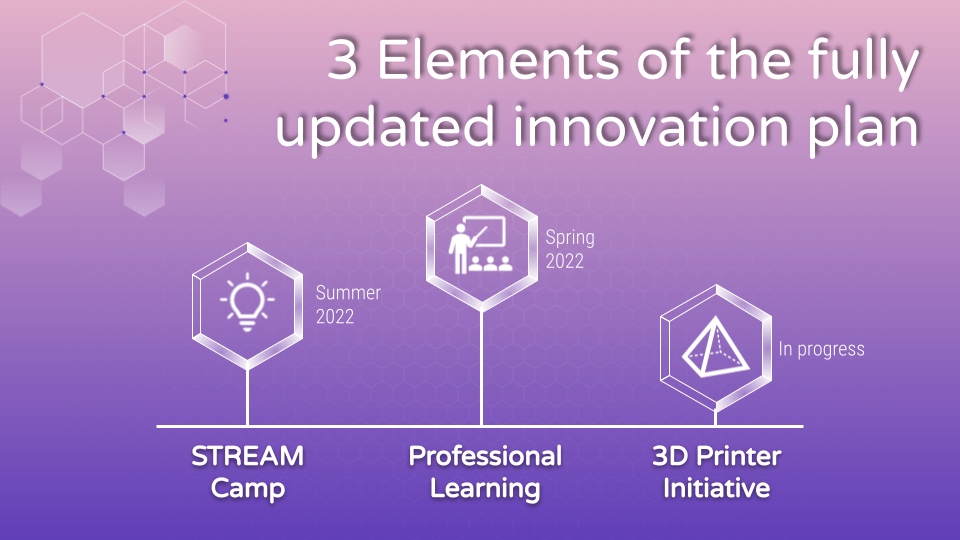
The main innovations of library summer STREAM camp in my original innovation plan were:
- Hosting virtual learners – 👍🏼
- Including 3D printing – 🤷🏻♀️
- Hosting a separate camp for middle school students 👍🏼
As I consider the overarching questions, that has helped help me make the necessary modifications to my innovation plan.
- What worked? – Having a separate camp for middle school students went very well because they were able to engage in some higher level activities. The students at all levels engaged in stem challenges which they made mostly with common items found at home or supplies like plates, cups, straws and tape. Also the fact that we hosted virtual learners went well. Getting their supplies to them was manageable. However, we had fewer interested in participating in camp virtually than we had anticipated. Another element that worked really well was the fact that we had Kiwi kits. The original plan was to get those only for the virtual learners but we were able to provide them for everyone. They were a great addition to the STREAM Camp.
- What could have been done better? – The registration process was a little bit difficult because we had to make more space for face-to-face learners and it was work intensive. The supply ordering should have occurred earlier. It was also complicated by the fact that very late into the planning process, our district leadership requested that we expand all of the camps including, STREAM camp. Also, students reported that they would have enjoyed camp more if we had provided snacks.
- How to apply the lessons learned? I think the biggest lesson learned is to plan early, and take into consideration input from all of the stakeholders. Also, the kids need snacks!
Adjustments to innovation plan:
- Included below in the slideshow presentation are the overarching questions for the 3D printer initiative that we started this summer, providing each elementary library with a 3D printer. I intend to include this as part of my updated innovation plan as it is linked directly to STEM learning, and makerspaces in library learning hubs. STREAM camp did not allow for a lot of time for 3-D printers, so this element of the innovation plan will be in process throughout the whole school year, not just in the summer.
- The third element that I will add to my innovation plan is professional learning that we are planning for librarians by future ready presenter, Shannon McClintock Miller. While hosting professional learning may not seem like an innovation, I do consider it to be. We have not carved out opportunities beyond our monthly PLCs for librarians to learn very often in our district. They do go to their annual convention, but they deserve deeper learning experiences here at home. I first realized this as we learned in EDLD 5389 Effective Professional Learning. But it was confirmed for me as I did my research for the literature review as well. The need for STEM and makerspace professional learning was mentioned repeatedly in the research.
Below is the STREAM Camp portion of the updated innovation plan.
Here is a review of literature associated with STEM learning in libraries. In my research, I found that as job opportunities for STEM focused careers are on the rise, libraries are a wonderful environment for sparking an interest in these topics. For this to be successful, our librarians need adequate professional learning opportunities to develop their skills to help students stretch their exploration.
This is the call to action video which establishes the need for continued support of library innovation in our district.
References:
- Cmoeinc. (2013). How To Get Quick Feedback With The Plus Delta Tool. YouTube. Retrieved October 6, 2021, from https://youtu.be/ADEd0IIswpQ.
- Girl Scouts of the USA. (2012). Generation STEM – full report – girl scouts. https://www.girlscouts.org/. Retrieved October 21, 2021, from https://www.girlscouts.org/content/dam/girlscouts-gsusa/forms-and-documents/about-girl-scouts/research/generation_stem_full_report.pdf.
- Global Family Research Project. (2019). Public libraries engage families in STEM. Retrieved October 21, 2021, from https://globalfrp.org/content/download/472/4130/file/GFRP_STEMPolicyBrief_2019.pdf.
- Johnson, D. (2010, August 11). Changed but still critical – part one of two – home – The Blue Skunk Blog. Retrieved October 21, 2021, from http://doug-johnson.squarespace.com/blue-skunk-blog/2010/8/11/changed-but-still-critical-part-one-of-two.html
- Koester, A. (2013, October 1). Full steam ahead: Injecting art and creativity into stem. School Library Journal. Retrieved October 21, 2021, from https://www.slj.com/?detailStory=full-steam-ahead-injecting-art-and-creativity-into-stem.
- STEM Resources Task Force. (2013, December 14). Steam* Programming Toolkit – ala.org. Young Adult Library Services Association. Retrieved October 21, 2021, from https://www.ala.org/yalsa/sites/ala.org.yalsa/files/content/2016%20STEAM%20TOOLKIT.pdf.
STEM, STEAM, STREAM and Makerspaces in Library Learning Hubs
References:
- Cmoeinc. (2013). How To Get Quick Feedback With The Plus Delta Tool. YouTube. Retrieved October 6, 2021, from https://youtu.be/ADEd0IIswpQ.
- Girl Scouts of the USA. (2012). Generation STEM – full report – girl scouts. https://www.girlscouts.org/. Retrieved October 21, 2021, from https://www.girlscouts.org/content/dam/girlscouts-gsusa/forms-and-documents/about-girl-scouts/research/generation_stem_full_report.pdf.
- Global Family Research Project. (2019). Public libraries engage families in STEM. Retrieved October 21, 2021, from https://globalfrp.org/content/download/472/4130/file/GFRP_STEMPolicyBrief_2019.pdf.
- Johnson, D. (2010, August 11). Changed but still critical – part one of two – home – The Blue Skunk Blog. Retrieved October 21, 2021, from http://doug-johnson.squarespace.com/blue-skunk-blog/2010/8/11/changed-but-still-critical-part-one-of-two.html
- Koester, A. (2013, October 1). Full steam ahead: Injecting art and creativity into stem. School Library Journal. Retrieved October 21, 2021, from https://www.slj.com/?detailStory=full-steam-ahead-injecting-art-and-creativity-into-stem.
- STEM Resources Task Force. (2013, December 14). Steam* Programming Toolkit – ala.org. Young Adult Library Services Association. Retrieved October 21, 2021, from https://www.ala.org/yalsa/sites/ala.org.yalsa/files/content/2016%20STEAM%20TOOLKIT.pdf.
Professional Learning Plan & Resources
Bringing together the 3-year Blended Learning & Coaching Plan
This post is a modification of a previous post from September 12, 2021.
As the District Instructional Technologist for elementary, I propose to enact an innovative, comprehensive, alternative instructional technology professional learning plan that will continue our district’s solid tradition of providing high-quality professional learning opportunities for teachers, but also enhance it.
Building a high-quality 3-year plan for innovative professional learning requires school leaders to take much into consideration, including but not limited to:
- The need for alternative professional learning – outlined in a previous post
- The principals of effective professional learning
- The learning audience and their needs
- Timeline
- Collaboration, Modeling & Coaching
- Encouraging self-directed learning
- Areas of Responsibility (Leaders, Presenters & Participants)
- Necessary Resources
My hope is that this alternative learning plan will be the steps we need to take in the right direction toward building a digital learning ecosystem. With the skills they build for themselves and their colleagues, teachers will be able to masterfully integrate technology and blended learning strategies when the situation calls for it.
One pervasive message that I hope to include is that learning is not dependent upon a particular product or platform. Rather, teachers and students are able to be adaptable and create with various tools. The primary purpose for this is that teachers and students need to be taught ways to empower themselves. Therefore, this three-year plan encompasses the use of various digital tools. However, it’s not the ability to use the tools that is so critical. What is important is how 21st-century learning skills can be addressed in conjunction with authentic learning and problem-solving.

It is the ability of teachers and students to be able to powerfully use whichever tool is most appropriate to construct their learning that will build our digital learning ecosystem.

Each group of learners has various needs to be successful throughout the professional learning plan. For example, tech-reluctant teachers may need more time to practice the skills. They will also need encouragement and support. All participants will need opportunities to go back to their classroom or regular environment to practice implementing the various strategies set forth. This could potentially be challenging for administrators that do not have as many teaching opportunities throughout the weeks and months. Therefore the vision is that they will take the skills and practice with their teachers, modeling the use of innovative strategies.

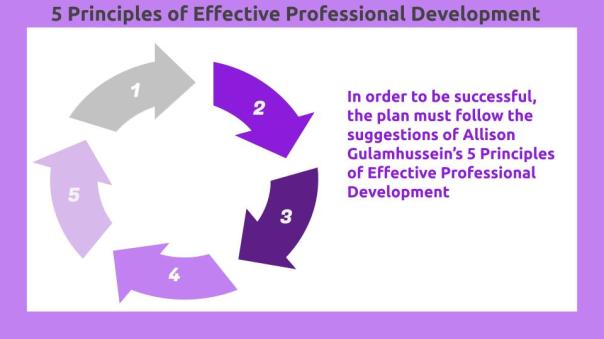
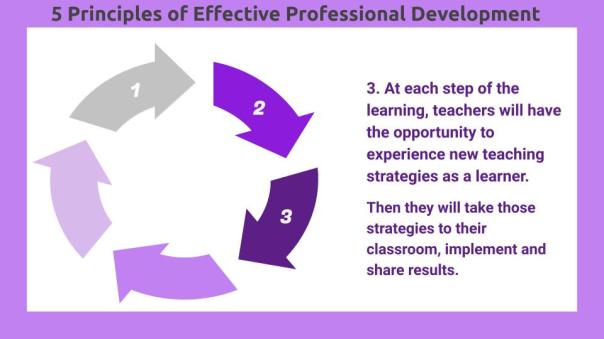
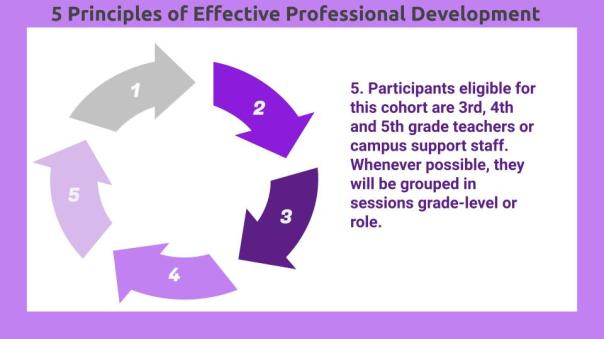
In order to be successful, the plan must follow the suggestions of Allison Gulamhussein’s 5 Principles of Effective Professional Development. This 3-year plan includes all 5 Principles, detailed in the slides below.




According to 2009 the Professional Learning in the Learning Profession: A Status Report on Teacher Development, effective professional development results in advanced teaching practice as well as improved student learning outcomes. The report also suggests that we consider teachers as lifelong learners and consider professional development to be more about teacher learning.
The learning opportunities provided to teachers throughout this plan will be varied enough to meet the needs of teachers of grades 3, 4, and 5 and campus admin support staff. Also, teachers and staff will have multiple opportunities throughout the year to apply these strategies in their own classrooms.
Collective work in trusting environments provides a basis for inquiry and reflection into teachers’ own practice, allowing teachers to take risks, solve problems and attend to dilemmas in their practice.
Professional Learning in the Learning Profession: A Status Report on Teacher Developmen
The primary goal of the professional learning plan is to help these participants become more effective teachers, and increase student achievement. Beyond that, we are preparing leaders. The participants will commit to the three-year plan. Part of the commitment is to provide professional learning opportunities on their campus or at the district level. After, or throughout the first year, participants may share blended learning strategies. After the second year, they may provide training from skills they learned in the Microsoft Innovative Educator Trainer series or the Apple Teacher series. To achieve success in the professional learning plan, teachers must remain motivated and self-directed.
As research deepens our understanding of how teachers learn, many scholars have begun to place greater emphasis on job-embedded and collaborative teacher learning.
Professional Learning in the Learning Profession: A Status Report on Teacher Development
Collaboration and coaching in the area of professional learning are essential. By including campus administrative staff in the learning session with teachers, I hope to develop further collaboration possibilities. As curriculum specialists, librarians, campus techs, and principals learn with the teachers, they may also work together to share that learning with other staff members in the school. The goal is to exemplify the Innovation that Sticks Case Study, in which one leader described their successful professional learning model, with school leaders learning side-by-side with the teachers, fully involved.
Another element of collaboration is that teachers will be able to visit each other’s classrooms to observe the implementation of strategies learned throughout the three years of the plan. Additionally, throughout the 3 year period, teachers will have opportunities to design and share lesson plan exemplars. The other teachers in their professional learning cohort will be available for them to evaluate their lesson and suggest alternatives and give feedback.
The goal is for teachers to develop those observation skills into coaching skills by the third year.
Hopefully, by the end of year three, we will have 60 solidly trained, confident elementary educators equipped with the knowledge and skills they need to transform their classrooms and schools. These educators will be able to blaze the trail by coaching their colleagues and supporting students in their digital learning ecosystem.

As the Blended Learning Cohort of Year 1 is presented by the Powerschool PD team, they will provide all of the materials for each session. Most of these materials, including slide decks and discussion posts, are online within our learning management system Schoology. They will also provide Catlin Tucker’s book to each participant, Blended Learning in Grades 4-12, Leveraging the Power of Technology to Create Student-Centered Classrooms.
For Year 2, all of the materials are hosted online through the two websites:
For Year 3, my colleague and I plan to teach 9 sessions, completely based on Elena Aguilar’s Art of Coaching Workbook. The sessions will be a mix of half-day face to face sessions, and two hour virtual sessions. Below is the beginning of slide deck for Session 1 – Figuring Out Who You Want to Be. All participants will be provided two books:
- The Art of Coaching – Effective Strategies for School Transformation
- The Art of Coaching Workbook – Tools to Make Every Conversation Count
Below are the detailed Backward Design Plan and the Significant Learning Outcomes Plan with a 3-column table.

Citations:
- Aguilar, E. (2020). Art of coaching: Effective strategies for school transformation. JOSSEY-BASS.
- Amico. (n.d.). Knowledge Isometric Illustrations. Storyset. Retrieved September 12, 2021, from https://storyset.com/education.
- 4K HD Free Stock Footage No Copyrights. (2020). Kids Free Hd Stock Footage For Download and Reuse Without Copyright. YouTube. https://youtu.be/ENi-gJVCjeQ.
- Andrews, T. M., Leonard, M. J., Colgrove, C. A., & Kalinowski, S. T. (2017). Active learning not associated with student learning in a random sample of college biology courses. CBE—Life Sciences Education, 10(4), 394–405. https://doi.org/10.1187/cbe.11-07-0061
- CEA. (2016). (rep.). The CEA ‘Innovation that Sticks’ Case Study Report Ottawa Catholic School Board A Framework for District-Wide Change. Toronto, ON. https://www.edcan.ca/wp-content/uploads/cea_ocsb_innovation_report.pdf
- EdCan Network Le Réseau ÉdCan. (2016). Innovation That Sticks Case Study – Ocsb: Collaborative Professional Development. YouTube. https://www.youtube.com/watch?v=iUusuw-xdr4.
- Education – k-12 – apple teacher. Apple. (n.d.). Retrieved September 11, 2021, from https://www.apple.com/education/k12/apple-teacher/.
- Hill, Heather C. (2015, September). Review of the mirage: confronting the hard truth about the quest for teacher development.
- Glatch, S., Mahoney, E., & Becky. (2021, July 30). The 5 stages of freytag’s pyramid: Introduction to dramatic structure. Writers.com. https://writers.com/freytags-pyramid.
- Goodwin, B. (2015, December 1). Research Says / Does Teacher Collaboration Promote Teacher Growth? ASCD. https://www.ascd.org/el/articles/does-teacher-collaboration-promote-teacher-growth.
- Gulamhussein, A. (2013, September) Teaching_Effective_Professional_Developmt.pdf. Dropbox. https://www.dropbox.com/s/j13c5mk092kmqv9/Teaching_Effective_Professional_Developmt.pdf?dl=0
- Life Mentor. (2018). Simon Sinek – How to present properly(Part 5). YouTube. https://youtu.be/msvmLlAkOno.
- Microsoft innovative Educator Programs. Microsoft Educator Center. (n.d.). Retrieved September 11, 2021, from https://education.microsoft.com/en-us/resource/18485a7b.
- Stanford Graduate School of Business. (2013). Nancy Duarte: How to Tell a Story. YouTube. https://youtu.be/9JrRQ1oQWQk.
- The cure for bad powerpoint: A review of presentation zen. Cult of Pedagogy. (2020, June 13). https://www.cultofpedagogy.com/presentation-zen/.
- Wei, R. C., Darling-Hammond, L., Andree, A., Richardson, N., & Orphanos, S. (2009). Professional Learning in the Learning Profession: A Status Report on Teacher Development in the U.S. and Abroad. Technical Report. National Staff Development Council.
- Watchel, T. (n.d.). Defining restorative: Restorative practices. IIRP. https://www.iirp.edu/restorative-practices/defining-restorative/.

Transformative Professional Learning Plan
Overview of the 3-year Blended Learning & Coaching Plan
High quality professional learning is a strength of the Killeen Independent School District. As the District Instructional Technologist for elementary, I propose to enact an innovative, comprehensive, alternative instructional technology professional learning plan that will continue that solid tradition of providing high-quality professional learning opportunities for teachers, but also enhance it.
My hope is that this alternative learning plan will be the steps we need to take in the right direction toward building a digital learning ecosystem. With the skills they build for themselves and their colleagues, teachers will be able to masterfully integrate technology and blended learning strategies when the situation calls for it.
In order to be successful, the plan must follow the suggestions of Allison Gulamhussein’s 5 Principles of Effective Professional Development. This 3 year plan includes all 5 Principles.
- The duration of professional learning must be significant and ongoing to allow time for teachers to learn a new strategy and grapple with the implementation problem. This plan will take place across 3 years. Teachers will have multiple opportunities to develop their skills.
- There must be support for a teacher during the implementation stage that addresses the specific challenges of changing classroom practice. At each stage of the professional learning plan, teachers will have the support of presenters, colleagues, and administrators.
- Teachers’ initial exposure to a concept should not be passive, but rather should engage teachers through varied approaches so they can participate actively in making sense of a new practice. At each step of the learning, teachers will have the opportunity to experience new teaching strategies as a learner. Then they will take those strategies to their classroom, implement and share results.
- Modeling has been found to be highly effective in helping teachers understand a new practice. Teachers will experience modeling in Year 1 by observing the Blended Learning Cohort trainer and in Years 2 & 3 by observing their colleagues in the cohort.
- The content presented to teachers shouldn’t be generic, but instead specific to the discipline (for middle school and high school teachers) or grade-level (for elementary school teachers). Participants eligible for this cohort are 3rd, 4th and 5th grade teachers or campus support staff. Whenever possible, they will be grouped in sessions grade-level or role.
Collective work in trusting environments provides a basis for inquiry and reflection into teachers’ own practice, allowing teachers to take risks, solve problems and attend to dilemmas in their practice.
Professional Learning in the Learning Profession: A Status Report on Teacher Development
According to 2009 the Professional Learning in the Learning Profession: A Status Report on Teacher Development, effective professional development results in advanced teaching practice as well as improved student learning outcomes. The report also suggest that we consider teachers as lifelong learners and consider professional development to be more about the teacher learning.
The learning opportunities provided to teachers throughout this plan will be varied enough to meet the needs of teachers of grades 3, 4 and 5 and campus admin support staff. Also, teachers and staff will have multiple opportunities throughout the year to apply these strategies in their own classroom.
As research deepens our understanding of how teachers learn, many scholars have begun to place greater emphasis on job-embedded and collaborative teacher learning.
Professional Learning in the Learning Profession: A Status Report on Teacher Development
Collaboration and coaching in the area of professional learning are essential. By including campus administrative staff in the learning session with teachers, I hope to develop further the collaboration possibilities. As curriculum specialists, librarian, campus techs and principals learn with the teachers, they may also work together to share that learning with other staff members in the school. The goal is to exemplify the Innovation that Sticks Case Study, in which one leader described their successful professional learning model, with school leaders learning side-by-side with the teachers, fully involved.
Another element of collaboration is that teachers will be able to visit each other’s classroom to observe the implementation of strategies learned throughout the three years of the plan. The goal is for teachers to develop those observation skills into coaching skills by the third year.
Hopefully, by the end of year three, we will have 60 solidly trained, confident elementary educators equipped with the knowledge and skills they need to transform their classrooms and schools. These educators will be able to blaze the trail by coaching their colleagues and supporting students in their digital learning ecosystem.
Below are the beginnings of my Backward Design Plan as well as the Significant Learning Outcomes Plan with a 3-column Table. These are still being fully developed for the final evaluation.
References:
Aguilar, E. (2020). Art of coaching: Effective strategies for school transformation. JOSSEY-BASS.
Amico. (n.d.). Knowledge Isometric Illustrations. Storyset. Retrieved September 12, 2021, from https://storyset.com/education.
CEA. (2016). (rep.). The CEA ‘Innovation that Sticks’ Case Study Report Ottawa Catholic School Board A Framework for District-Wide Change. Toronto, ON. https://www.edcan.ca/wp-content/uploads/cea_ocsb_innovation_report.pdf
Education – k-12 – apple teacher. Apple. (n.d.). Retrieved September 11, 2021, from https://www.apple.com/education/k12/apple-teacher/.
Hill, Heather C. (2015, September). Review of the mirage: confronting the hard truth about the quest for teacher development.
Gulamhussein, A. (2013, September) Teaching_Effective_Professional_Developmt.pdf. Dropbox. https://www.dropbox.com/s/j13c5mk092kmqv9/Teaching_Effective_Professional_Developmt.pdf?dl=0
Microsoft innovative Educator Programs. Microsoft Educator Center. (n.d.). Retrieved September 11, 2021, from https://education.microsoft.com/en-us/resource/18485a7b.
Wei, R. C., Darling-Hammond, L., Andree, A., Richardson, N., & Orphanos, S. (2009). Professional Learning in the Learning Profession: A Status Report on Teacher Development in the U.S. and Abroad. Technical Report. National Staff Development Council.
 Holly D. Landez ePortfolio