Holly D. Landez ePortfolio
A Collection of My Work in edTech

Reflections on Ownership

own·er·ship | \ ˈō-nər-ˌship \ noun – the state, relation, or fact of being an owner
With the COVA and CSLE approach, all of the elements must be present for meaningful learning to occur. For students to have ownership of their learning, they need to be engaged in authentic learning opportunities. The current traditional model of instruction very ofter requires teachers to provide very specific content to students with very tight time constraints in order to prepare students for an assessment. If students have little choice in the material they are to learn, and if it is not grounded in authentic opportunities, then they do not own the learning. Therefore, for true ownership of the learning to occur, the teacher needs to step back a bit, and relinquish control while students work to solve authentic problems.
Dr. Thibedeaux stated in her Learner’s Mindset post that, “Constructivists, like Jonassen (1999), argue that ownership of the problem is key to learning because it increases learner engagement and motivation to seek out solutions.”
“Ownership of learning is all about building the adaptability, confidence, character, grit, and a growth and learners mindset that is required for our learners to address the problems and challenges of the complex world in which we live.”
HARAPNUIK & THIbodeaux
Ownership of learning and authentic learning opportunities present themselves organically in real life parenting situations. However, I believe it can be more challenging for teachers to guide students to these authentic learning opportunities that build in ownership. It can feel like a departure from our current instructional practices to reliqush control. Creating that sort of significant learning environment is challenging, but not impossible.
In the COVA book, Dr. Harapnuik relates a story of his son taking on an extra responsibility of house-sitting. It was difficult for him step back, observe his child struggle with the extra responsibility, and allow him to come to conclusions on his own. That is the nature of parenting, relinquishing control and understanding that is the only way for the child to grow. I can completely identify with this situation, as think of a multitude of similar examples from my own parenting experiences.
The challenge now for teachers is to find ways to connect authentic learning opportunities to the standards, goals, and content that they are tasked with addressing. An additional layer of the challenge is for teachers to be able to give students the time they need to invest in the authentic learning projects. Students need time to formulate their ideas for the project or problem, time to research, and time to create their presentation product or some evidence of learning.
In this EDLD 5303 course, Applying Educational Technology Portfolio, we were given the space and time we needed to create our ePortfolios, collaborate with peers in groups of our choice and formulate thoughtful discussion and blog posts associated with the ideas around ePortfolios and the COVA approach.
The life lessons learned through taking full ownership of a learning opportunity cannot be matched by any form of direct instruction or teacher-controlled experience.
Harapnuik & ThibodeauX
In his YouTube video, John Spencer describes the need to find ways for students to own their learning.

AJ Juliani shares some phenomonal first-hand accounts of empowering students with ownership in this blog post and with the Epic Guide to Student Ownership.
References:
7 Things That Happen When Students Own Their Learning. (2017) https://youtu.be/N7S9kyk-odA.
Juliani, A. (2018, October 15). The epic guide to student ownership. Retrieved February 25, 2021, from http://ajjuliani.com/epic-guide-student-ownership/
Bray, B. (2018, February 10). Development of Ownership: From Compliance to Autonomy. Rethinking Learning. https://barbarabray.net/2018/02/10/continuum-of-ownership-developing-autonomy/.
Duckworth, S. (2018, September 9). Continuum of Ownership. Sylvia Duckworth. https://sylviaduckworth.com/.
Harapnuik, D., Thibodeaux , T., & Cummings, C. (2018). Cova: Choice, Ownership and Voice through Authentic Learning (Vol. .9). Creative Commons.
Thibodeaux, T. Learner’s Mindset….. Learners Mindset. http://tilisathibodeaux.com/wordpress/?page_id=538.
Reflections on Voice

voice \ ˈvȯis \ noun – wish, choice, or opinion openly or formally expressed
Without motivation, there is no push to learn; without engagement there is no way to learn; and without voice, there is no authenticity in the learning. For students to create new knowledge, succeed academically, and develop into healthy adults, they require each of these experiences.
-Toshalis and Nakkula
Two of the Keys to Voice found in the COVA Book are:
- Voice is the oral or written manifestation of a learner’s choice and ownership oftheir authentic learning opportunity.
- Without choice and ownership there will be no authentic voice.
Dr. Thibodeaux states in her COVA Learner’s Mindset blog post that “rather than allow the learner’s voice to be continually quenched by our content and standards-based system the authors argue that we need to create a learning environment that helps to nurture learner’s voice.” Voice is one elements of the COVA approach and CSLE (creating significant learning environments) that must be intertwined with all of the other elements. Students need each of these elements to support greater learning.
One of my biggest takeaways of the Lamar Digital Learning and Leading program is that I am finding my own voice. I never thought that I had much to say. But I have recognized at work that I often feel frustrated when I’m not able to easily express my opinions. For example, frequently in meetings, everyone is trying to share their ideas all at once. It can be hard to find a good jumping in spot, particularly if you have a quiet voice and masks make it harder to be heard. I am learning that it takes me longer to formulate my ideas. But once I have those ideas, I am able to express them well in writing.
Student voice in learning goes beyond being able to express themselves with words. It includes having a say in what and how the learning occurs. This video from the Vermont Agency of Education describes an excellent example of studnent voice in curriculum planning.
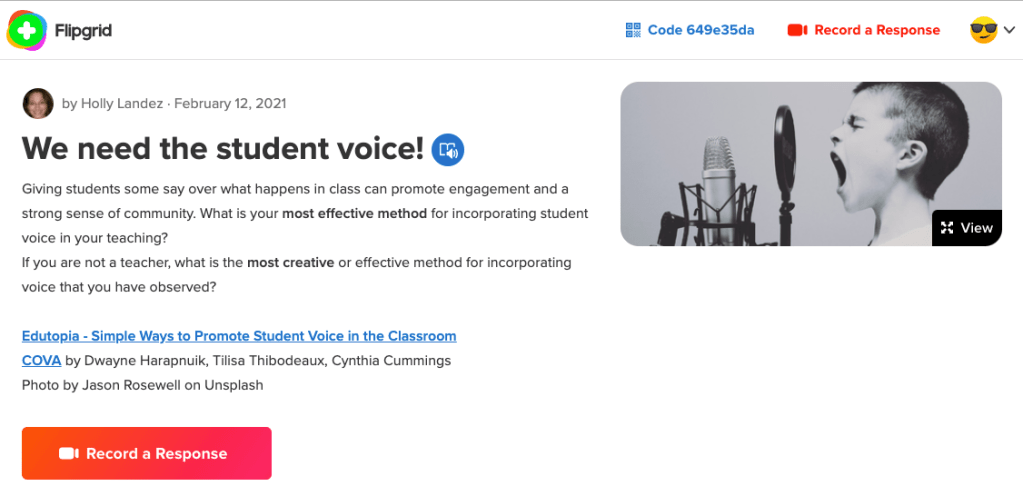
Flipgrid is a free, fun and innovative digital tool which allows teachers to empower the student voice. This article is a great introduction for teachers that want to learn more about Flipgrid. I created a Flipgrid to have the opportunity to practice using the tool and to give visitors the opportunity to sound off on their ideas about student voice. There are only a few responses so far, but I welcome anyone that is interested in responding.
This Edutopia article provides some Simple Ways to Promote Student Voice in the Classroom. Some tips are to have a welcoming ritual, plan consistent opportunites for voice, and to use student feedback.
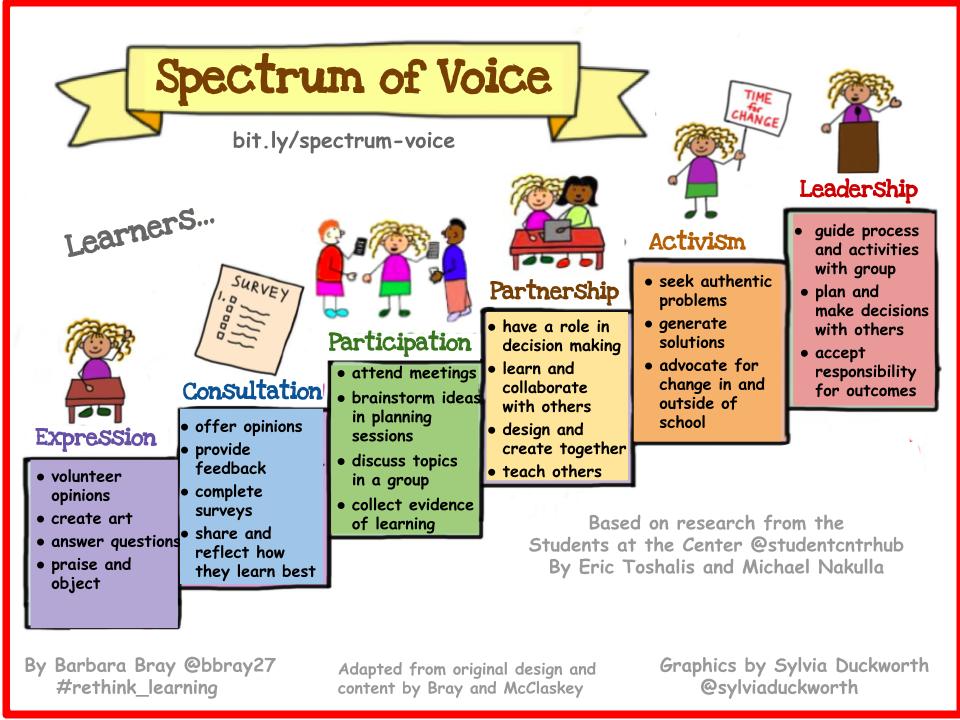
Barbara Bray explains in her Rethinking Learning article that “Voice gives students a chance to share their opinions about something they believe in.” She outlines the work of Eric Toshalis and Michael Nakulla to describe the various levels of student voice.
Finding one’s voice through authentic learning opportunities enables learners to transform their own learning by deepening their understanding, grounding their thinking, developing a sense of purpose and personal significance. This all contributes to the self-efficacy of the individual which can also influence the collective-efficacy.
Harapnuik & Thibodeaux
Bray, B. (2018, September 9). Spectrum of Voice: Developing Self-Regulation, Autonomy, and Agency. Rethinking Learning. https://barbarabray.net/2018/09/09/spectrum-of-voice-developing-self-regulation-autonomy-and-agency/.
Beblow, V. (2018, October 26). Empowering Student Voice with Flipgrid. Microsoft EDU. https://educationblog.microsoft.com/en-ca/2018/10/empowering-student-voice-with-flipgrid/.
Duckworth, S. (2018, September 9). Spectrum of Voice. Sylvia Duckworth. https://sylviaduckworth.com/.
Harapnuik, D., Thibodeaux , T., & Cummings, C. (2018). Cova: Choice, Ownership and Voice through Authentic Learning (Vol. .9). Creative Commons.
Pandolpho, B. (2020, March 10). Simple Ways to Promote Student Voice in the Classroom. Edutopia. https://www.edutopia.org/article/simple-ways-promote-student-voice-classroom.
Thibodeaux, T. Learner’s Mindset….. Learners Mindset. http://tilisathibodeaux.com/wordpress/?page_id=538.
Toshalis, E., & Nakkula, M. (2012). Motivation, Engagement, and Student Voice. Students at the Center. https://studentsatthecenterhub.org/resource/motivation-engagement-and-student-voice/.
Vermont Agency of Education. (2017). Student Voice and Choice. https://youtu.be/MVRCEq5jZkU.
Reflections on Authentic Learning

au·then·tic | \ ə-ˈthen-tik , ȯ- \ adjective – true to one’s own personality, spirit, or character
Did you ever have a situation where a parent, teacher, older sibling or other authority figure tried to explain something to you or teach you something, but the message didn’t stick until you had been through that experience? I can think of many examples from my personal life both as a child (teen) and as a parent. I have heard myself say, “This is a lesson I had to learn myself.”
True authentic learning occurs through experience. Very often parents have to stay on the outside and observe their children authentically learning a life lesson. How can teachers create authentic learning experiences in the classroom so that students can thrive in the real world?
Our job as teachers is not to “prepare” kids for something; our job is to help kids learn to prepare themselves for anything.
AJ Juliani
Authentic learning can be the result of creating a significant learning environment that incorporates student voice, choice and ownership. Project-based learning is a good starting place for teachers, but that is not the end result. According to the COVA book by Harapnuik & Thibodeaux, “authentic projects work because they not only give the learner choice and ownership over the world that they live in, but they also give the learner the ability to find and use their voice and show the world what they have created.” There are other key factors that define authentic learning opportunities:
- Real-world application that serves a purpose, solves a problem or addresses an actual need.
- Involves analysis, synthesis, design, and creation and is something that can be done or implemented.
- Is chosen and owned by the individual but still offers an impact to a broader audience.
- Is intended for an audience other than the individual or the instructors.
- Has social or collaborative component and extends beyond the classroom.
- Has an aspect of permanence or form of extended duration.
- Requires instructors come along side learners and help them guide their projects as facilitators, coaches or mentors. (Harapnuik, Thibodeaux, 2018).
On her User-Generated Education blog, author Jackie Gerstein states that “providing authentic and vigorous learning experiences to all learners should be the highest prior for all administrators, curriculum developers, and teachers” and that “learners view their experiences as having relevancy to their own lives, that they address their interests and needs.” The image below shows some of the additional benefits of authentic learning opportunities.

The concepts behind the importance of authentic learning opportunities are rooted in constructivism and in part the theories of John Dewey, who believed that learning should be experiential. “Constructivism transforms the student from a passive recipient of information to an active participant in the learning process.” (Matsouka, 2004). The ideas behind authentic learning opportunities takes that a step further and include that the learning students acquire should make a change in them or a change for others around them. This video describes the ideas of John Dewey and his influence on the education system.
Authentic learning is learning designed to connect what students are taught in school to real-world issues, problems, and applications; learning experiences should mirror the complexities and ambiguities of real life
Ted Dintersmith, the producer of the documentary Most Likely to Succeed, describes how the idea for his movie originated, and some of the experiences he had the support the validity and need for providing authentic learning opportunities. He asserts that students need to be afforded relevant opportunities to be creative innovators in order to succeed. His inspiring movie highlights some wonderful examples of authentic learning at work.
References:
Gerstein, J. (2019, March 11). Authentic Learning Experiences. User Generated Education. https://usergeneratededucation.wordpress.com/2019/01/20/authentic-learning-experiences/.
Harapnuik, D., Thibodeaux , T., & Cummings, C. (2018). Cova: Choice, Ownership and Voice through Authentic Learning (Vol. .9). Creative Commons.
Matsuoka, B. (2004). Constructivism as a paradigm for teaching and learning. Retrieved February 16, 2021, from https://www.thirteen.org/edonline/concept2class/constructivism/
Pearce, S. (2016, April). Authentic learning: what, why and how? ACEL. http://www.acel.org.au/acel/ACEL_docs/Publications/e-Teaching/2016/e-Teaching_2016_10.pdf.
Sprouts. (2021). John Dewey’s 4 Principles of Progressive Education. https://youtu.be/y3fm6wNzK70.
TEDx Talks. (2015). Ted Dintersmith Why Schools Should Teach for the Real World . YouTube. https://www.youtube.com/watch?v=Rvhb9aoyeZs.
Thibodeaux, T. Learner’s Mindset….. Learners Mindset. http://tilisathibodeaux.com/wordpress/?page_id=538.
From the standpoint of the child, the great waste in school comes from his inability to utilize the experience he gets outside while on the other hand he is unable to apply in daily life what he is learning in school. That is the isolation of the school–it’s isolation from life.
Dewey, 1915
Comparing ePortfolio Platforms

When I started this program, I believed I had a clear understanding of what an ePortfolio could be. Throughout the past three courses of the Digital Learning and Leading program, I have adjusted my ideas and expanded my view. Students at the elementary level should be able to explore and build content within platforms that are monitored by teachers. Although it allows less variability, we still have to moderate and monitor the online content that students under the age of 13 are creating, due to COPPA. This does not need to limit student creativity, voice or choice however. There are many tools that students can use to collect and display pride work while maintaining privacy and still encouraging creativity.
However, secondary students have more flexibility and can potentially be given the freedom to create content in the platform of their choice. There are some wonderful options. A few of them are listed below. I also found a Website Tool Tester that details comparisons of many site builders.
There is a movement on some college campuses called a Domain of One’s Own that allows students to keep their domain after they have left the institution. This has a several implications which are outlined in this Educause article. This allows students some liberty with their digital identity and the ability to maintain their digital creations and build upon their learning year after year.
As I have been building my ePortfolio in WordPress, I previewed some other tools here are some notes about each of them. There are many other tools which I did not feature here, these are just notes about the tools that I checked out. This Edutopia article presents two of my favorite creativity tools, Book Creator and Flipgrid as portfolios which I have never considered.
Adobe Spark Page – Adobe Spark is a wonderful creativity tool that is free for educational institutions. The basic Adobe Spark is free, but the premium education version has additional features such as collaboration and access to premium templates. It is an excellent platform for students to create and show their learning. However it is much less flexible than Google sites, Wix, Weebly, or WordPress. There is not an ability to add extensive widgets or subscribe to blog posts, or comment. Here is an example Spark Page portfolio.
Google Sites – many of my classmates suggested using Google sites and have been building their portfolio there. It is easy for them to establish a site as their districts use Google schools. Students using Google Sites would not be able to easily take all of their digital content when they leave their institutions. It is my understanding that Google sites has minimal themes and it is easy to navigate. When I reviewed Google Sites, I didn’t find it as easy to set up as I had hoped. Also there are some limits with domain names. If students do not use a bit.ly link, the URL for their site is quite lengthy. There is a possibility of connecting a domain name, but there is a cost associated with that.
Seesaw – Seesaw is a digital portfolio and platform for digital learning activities appropriate for elementary students. It is very limited in it’s capabilities and the teacher maintains the majority of the control. Parent are able to download student journals which contains every journal entry and activity that students have submitted. This does give parents a nice digital momento as students are able to easily record videos and upload drawings to the platform. It is a viable way for teachers and parents to see growth and progress.
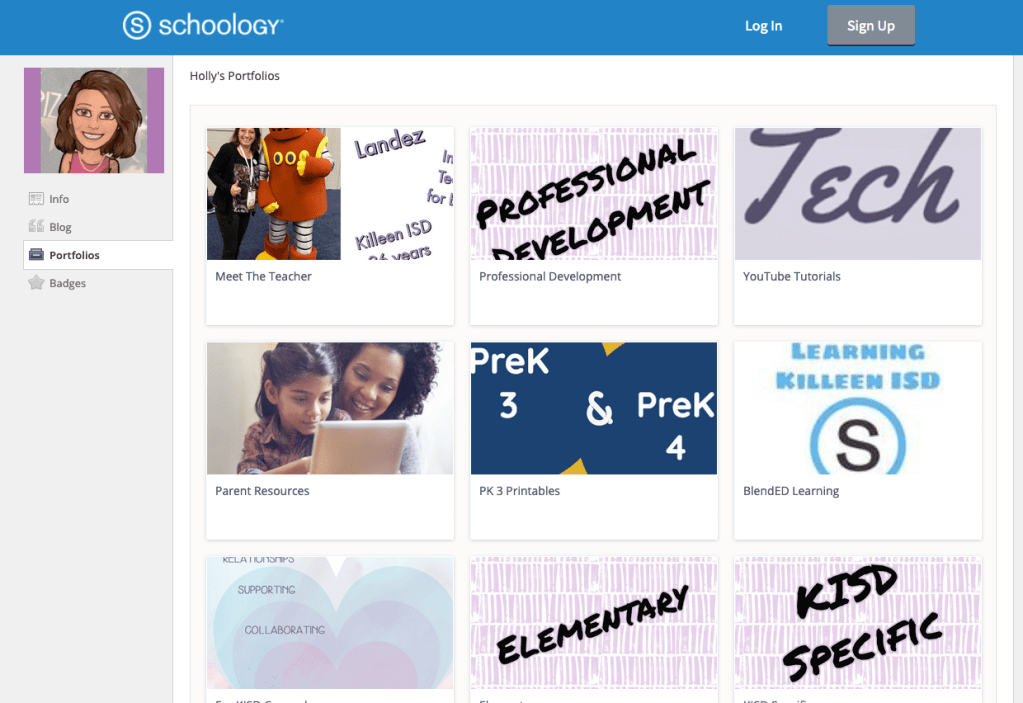
Schoology – The learning management system Schoology does have a portfolio feature. It seems to be underutilized as many people do not share work in that forum. I am able to see the benefits of having students, particularly middle school students, save their pride work there. However the Schoology portfolios does not offer the flexibility that students may find on Google sites, Wix, Weebly or WordPress. Also when the student leaves the institution, they are able to individual download zip files of each folder of work. Students are not able to keep all of the files intact in the organization that they set up. The Schoology portfolio definitely has limits. Students are not able to create or purchase a domain name. The only real creative flexibility is that users are able to add an image to each folder in the portfolio. I have an example that I use for demonstrations with teachers.
Wix – During our first DLL course, Disruptive Innovation, I signed up for a free account on Wix, and browsed around. The pricing seemed reasonable and the templates were slick! I considered setting up a domain name, but I did not follow through. The templates that I looked at had some wonderful images built in and I was not feeling inspired to insert specific images when I didn’t have content created yet.
Weebly – I had a very similar experience with Weebly as I did with Wix. However, I did not find templates. The site set-up seemed a little bit blah and I really needed a starting point. I felt a little bit like Goldilocks. Wix had too much guidance in the form of templates, Weebly didn’t have quite enough. The templates probably came later, but I didn’t put enough time into it to locate them.
WordPress – I settled on WordPress for multiple reasons. Primarily, I had already set up a personal website in WordPress previously and purchased a domain name years ago. It was long expired, but I remembered that I had been able to set it up with minimal effort, so there was comfort in that. Full disclosure, the reason I got an early start on my portfolio was because it felt fun, and more engaging than writing a literature review. A domain name seemed like a really cool place to start. Then I would finally feel some ownership. Well ownership is not always free, is it? So I purchased the domain name and paid for the premium features of WordPress. $100 a year didn’t seem like too much to be able to get me through my graduate program. Then I got really jazzed about making a little image for a tab label. I chose a minimal type theme and realized that I was not locked into a page full of images. My next step was to make an about page because that seemed easy enough. I use Dr. Thibodeaux’s and Dr. Harapnuik’s portfolios as inspiration for starting points. After that, I used the sites of other DLL students to guide the planning of my site. I am fairly certain that I did not choose the easiest tool, or even the least expensive. I was drawn to WordPress because I had used it before and it is one the teachers were advocating. My choice to stay with WordPress was because I had a substantial time and financial investment by the time we started this third class EDLD 5303, Applying Educational Technology Portfolio. Now I am able to navigate the pages fairly well, and enjoy adding the widgets and experimenting with adding various forms of media. I did stop myself from purchasing the business plan in order to be able to use plug-ins. I did not want to go overboard, because I hope to maintain this site for years to come.
References:
Brandl, R. (2021, January 22). Best Website Builder 2021: I’ve Reviewed the 15 Best (& Worst). WebsiteToolTester. https://www.websitetooltester.com/en/best-website-builder/.
Groom, J. (2019, October 18). 7 Things You Should Know About a Domain of One’s Own. https://library.educause.edu/resources/2019/10/7-things-you-should-know-about-a-domain-of-ones-own.
Hertz, M. B. (2020, January 6). Tools for Creating Digital Student Portfolios. Edutopia. https://www.edutopia.org/article/tools-creating-digital-student-portfolios.
Applying Educational Technology Portfolio Reflection








In this session particularly, we needed to be the drivers of our own learning because the main graded assignment, our ePortfolio, was due at the end of the course. We did have instructional guides such as the COVA book and online resources, weekly Zoom meetings with Dr. Reed, weekly blog post prompts and weekly discussion board prompts. But we were given a lot a freedom so that there would be time to design the ePortfolio to be turned in at the end of the session. One element of this course that I really enjoyed was that we were to build a team of classmates with which to collaborate. My team is made up of some strong learners and we were able to push each other with positive encouragement. One of my group members took the initiative to create a Slack for us, and that has been an effective form of communication. I look forward to continuing to work with my group throughout the remainder of the program. Beyond our collaboration cohort, we also have the support of our other classmates. I certainly enjoy the element of proceeding through a program with the same cadre of students. We are getting to know each other and are able to provide encouragement through our weekly discussion board posts. One goal of mine is to improve on the feed forward to my classmates. While I am able to give positive encouragement, I do not feel as confident in the area of providing suggestions or asking questions about a classmate’s discussion post or product yet. I understand that developing the feed forward skill is an important facet of developing leadership ability, so I will aim to improve.
I have learned so much during this five week session of Applying Educational Technology Portfolio, EDLD 5303, the third course in our Digital Learning and Leading Master’s program at Lamar University! Although our five-week sessions seem to pass at warp speed, we learn so much.
In this session particularly, we needed to be the drivers of our own learning because the main graded assignment, our ePortfolio, was due at the end of the course.
- We had instructional guides:
- the COVA book
- online resources
- weekly Zoom meetings with Dr. Reed
- weekly blog post prompts
- weekly discussion board prompts
Also we were given a lot a freedom so that there would be time to design the ePortfolio to be turned in at the end of the session. One element of this course that I really enjoyed was that we were to build a team of classmates with which to collaborate. My team is made up of some strong learners and we were able to push each other with positive encouragement. One of my group members took the initiative to create a Slack for us, and that has been an effective form of communication. I look forward to continuing to work with my group throughout the remainder of the program. Beyond our collaboration cohort, we also have the support of our other classmates. I certainly enjoy the social support factor of proceeding through a program with the same cadre of students. We are getting to know each other and are able to provide encouragement through our weekly discussion board posts. One goal of mine is to improve on the feed forward to my classmates. While I am able to give positive encouragement, I do not feel as confident in the area of providing suggestions or asking questions about a classmate’s discussion post or product yet. I understand that developing the feed forward skill is an important facet of developing leadership ability, so I will aim to improve.
I felt that I had a good start to the minimum expectations of the ePortfolio when we started this session. There were a couple of specific elements that I needed to add, such as a section for Archives, and to ensure that commenting was enabled. I did some research about enabling comments on WordPress, and for the security of my site, I decided to keep the feature that a user must login with a WordPress or social media account to be able to leave a comment. Also I became heavily engaged in tagging blog posts after I created a tag cloud. I’m still floundering a bit between the idea of categories and tags, but after some reading I understand that categories are broad while tags are more specific. For now I will leave both active on my site and perhaps remove one later as it seems to make my site a little bit busy.
After reviewing some required resources, we were asked to create a discussion post about the reasons for creating ePortfolios. My thoughts are shared in this blog post called Process Before Product.
Who Owns the Portfolio, Who Owns the Ideas was a blog post modified from a discussion post based on that question. In that section of our course, I was fascinated to learn about the Domain of One’s Own movement.
We were asked to evaluate our ePortfolio platform to determine if it would be robust enough to carry us through the entire DLL program. Also we were to consider if the current platform we are using would be able to support future projects should we continue to use the ePortfolio beyond our time in the DLL program. I certainly intend to continue building upon and developing my ePortfolio in the WordPress platform throughout my career. Here are my ideas about various ePortfolio platforms.
A major portion of our learning this session was to read the COVA book written by Dr. Harapnuik, Dr. Thibodeaux, and Dr. Cummings. Reading this book absolutely helped solidify some ideas about choice, ownership, voice and authentic learning for me. After reading the book, I chose to create a mini blog post series about the elements of the COVA approach. In those posts, I included some notes about the work and ideas of other leading educators regarding choice, ownership, voice, and authentic learning. As I wrote and researched, I grappled with two questions.
1. If constructivist theories and ideas about authentic learning are not new, and they are taught to prospective teachers and leaders in preparation programs, and supported by research then why is our current public education system so driven by the specificity of standards and accountability via assessment?
If I persist with this line of thinking for very long, I become disheartened and negative. I came across a few pieces of information that have somewhat reassured me. In a Learner’s Mindset video, Dr. Thibodeaux and Dr. Harapnuik shared that while individuals do not have the means to overhaul the entire complex education system, teachers do have the means to develop their instruction to become more authentic one project at a time in their classroom. In the 4 Keys to CSLE + COVA video Dr. Harpnuik expressed that although the current education system is working, the real goal is to see what can improve. Further, I listened to a TeachThought podcast with Jared Cooney Horvath and David Bott, the authors of 10 Things Schools Get Wrong (and how we can get them right). They began the book with a similar idea. “The education system is not broken. Schools are succeeding.”
2. How can teachers of early learners and intermediate elementary students best create significant learning environments? Young learners still have the natural inquisitiveness, unbridled imagination and drive to learn, but they also need to learn to read and count.
These are ideas that I’m looking forward to exploring more in the next class session, Creating Significant Learning Environments, EDLD 5313.
Note: It was my original intent to include products of various digital tools within my COVA Blog Post Series. I had minimal responses to my first two attempts, which were a Flipgrid on student voice (posted in Student Lounge, Facebook & Twitter) and a question about ePortfolios on Facebook. Clearly I have not mastered crowdsourcing yet. That is another goal.
Exemplar ePortfolios

I appreciate the opportunity that we had to look over exemplar ePortfolios, examples of student portfolios at various levels, those of other DLL students, as well as portfolios and blog sites belonging to edtech professionals and bloggers. I spent a lot of time on this activity because like so many things online, it was a deep rabbit hole for me! On practically every single ePortfolio or blog site I found a new book to add to my Goodreads list, a new podcast to sample and save for later, an interesting resource, new people to follow on social media, or great nugget to retweet.
It is easy to become distracted and overwhelmed with the amount of information and content available to us. There is so much to discover, learn and connect to our world. My most effective method for not becoming overloaded with information is to consider my primary goal make that the target.
My target for this post is to focus on what I view are high points of 6 of the many suggested ePortfolio sites:
I was drawn to Jesse Lee’s University of Waterloo undergraduate ePortfolio because of its simplicity and organization. I was especially interested in his blog post about time management. While reading about the COVA method and having students develop authentic learning through solving real-world problems, I frequently wonder about teacher time management. In order for students to manage their time well, teachers have to create conversations about and model that as well. I suppose at the elementary level, the time that students have to work on projects must come in smaller chunks. In his blog post, Jesse provides great time management tips such as prioritizing, and setting smart goals. But more than that, Jesse tells his own story and what he has learned about the reasons for building time management skills.
I love Michelle Little’s site Little Tech Stop. Michelle incorporates some very creative elements in her portfolio, such as a Thinglink image that describes her Digital Learning & Leading Journey. Thinglink is one of those digital tools that I have visited multiple times, but have not used to created anything magnificent. I really like her example briefly describing each course on a winding road.
Jamie Velazquez’s WordPress portfolio is a lovely collection of posts that demonstrate the knowledge gained through her Digital Learning and Leading Journey, I especially enjoyed reading about her STEAM Lab Blended Learning Plan outlined in an infusion of the 5 Stages of Change and Covey’s Four Disciplines of Execution. This is something that I have never heard of. I haven’t see these ideas introduced on the sites of any other student or anywhere in our current course materials. This example is part of the beauty of the COVA and CSLE models. Learners are working toward a common goal, but are not necessarily limited by the granularity of one specific standard.
Bridget Gallagher’s portfolio created in Weebly was designed with elegant simplicity. I was especially interested in her post about Instructional Design in Online Learning. I am so looking forward to taking that class and learning more about effective ways to structure an online course. I’m not sure if you have noticed or not, but there is a huge proliferation of virtual courses available lately. Across the past two decades, there has been a gradual growth of online learning and virtual college courses. But suddenly, this past year, with the need for social distancing, virtual courses have exploded. Bridget’s model of effective course design heightens my enthusiasm for moving forward in the Lamar DLL program!
Lisa Nielsen, the Innovative Educator’s blogspot was interesting to me for multiple reasons. Primarily, she had a recent blog post about about a variety of suggested podcasts. Of course I had to go and subscribe to a couple, one of which was the Class of 2025 from Oregon Public Broadcasting, which focuses on current issues in public education. I like that Lisa’s contact was current. After being in education for a couple of decades, I have started projects in multiple platforms which have either been abandoned or become stale. I hope to be able to keep my current ePortfolio up-to-date and relevant. The other element of Lisa’s site that I really enjoyed was the variety of subject topics. The world of edTech and digital learning has so many areas to explore, and my interests are varied. Therefore I really value that Lisa posts content about teacher effectiveness, digital citizenship, mobile devices, social media and more.
I am a huge fan of George Couros, his books like the Innovators Mindset, and presentations. George emphasize the importance of relationships for effective and meaningful teaching and learning. His YouTube video Blog as Portfolio, finally helped me make the connection about why our blog posts are important elements of our ePortfolio. The posts reveal a journey of learning, and allow for greater demonstration of learning, and show evidence of abilities publicly. Also, on Geroge’s site there is a link to a great webinar that is an introduction to his portfolio master course, that emphasizes many of the concepts we have learned in this course.
Taking the time to review these sites, particularly the ones of my Digital Learning Leading predecessors, has given me insight into what is possible for my ePortfolio. I entered the program with a somewhat narrow and self-limiting view of the potential for my ePortfoilo. Digging into what other students have created before me has helped me up my game substantially!
“Digital portfolios push learning, help learners reflect on their growth over time, develop a library of learning, create opportunities, and build a digital footprint.”
-George Couros
Couros, G. (2021, February 9). George. George Couros. https://georgecouros.ca/blog/.
Covey, F. (2020, December 3). The 4 Disciplines. FranklinCovey. https://www.franklincovey.com/the-4-disciplines/.
Gallagher, B. (2018, July). Capstone. Bridget Gallagher. http://www.bridgetsgallagher.com/capstone.html.
Harapnuik, D. (2015, July 16). Show Me Yours and I Will Show You Mine – Eportfolio Examples. harapnuik.org. http://www.harapnuik.org/?s=eportfolio%2Bexample.
Lee, J. Welcome – Jesse Lee Business ePortfolio. Welcome – Jesse Lee Business ePortfolio – University of Waterloo. https://learn.uwaterloo.ca/d2l/eP/presentations/presentation_preview_popup.d2l?presId=509947&pageId=836542.
Little, M. (2018, July 29). Little Tech Stop. https://littletechstop.wordpress.com/.
Nielsen, L. (2021, February 7). Lisa Nielsen: The Innovative Educator. https://theinnovativeeducator.blogspot.com/.
Oregon Public Broadcasting. Class Of 2025. Spreaker. https://www.spreaker.com/show/class-of-2025.
Thinglink. Create unique experiences with interactive images, videos & 360° media. ThingLink. https://www.thinglink.com/.
Velazquez, J. (2018, November 3). Capstone: My Innovation Plan Reflection. My Learning Journey. https://jamievelazquezdlleportfolio.wordpress.com/2018/11/03/capstone-my-innovation-plan-reflection/.
YouTube. (2012). Blog as Portfolio. https://youtu.be/s4C69Lrpk1E.
Who Owns the Portfolio? Who Owns the Ideas?

In a recent class session we discussed who owns the learning portfolio. That was such an interesting discussion because we talked about the fact that an educational institution may own the data, but the learning, and intellectual property should belong to the student.
There is the ongoing problem of student data and creative products being lost when they leave the school if they do not purposefully transfer the data files somewhere. Herein lies the issue of using and LMS portfolio or school subscription cloud storage like Google Drive. Some schools are overcoming that problem by providing students with their own domain. When they leave an institution or graduate, their digital products can go with them. Programs like The Domain of One’s Own Initiative at UMW encourages students to maintain portfolio of artifacts and posts from their learning career.
This is a novel solution for a true problem!
Dr. Harapnuik takes this idea a step further in the Who Owns the Portfolio post. He suggests that more than the ownership of data, it is the ownership of ideas that is more important.
I thoroughly enjoyed the opinion article by Andrew Rikard Do I Own My Domain If You Grade It? He described how some teachers and students used the digital platform very similar to traditional classroom structure, giving an assignment and asking the students to post it int their domain.
This method very often lacks authenticity as the students are not choosing what belongs in their portfolio. I experienced a little bit of this in the previous class when I posted my work on my ePortfolio. While I believed in the quality of my work, I did not believe that anyone would be interested enough to read it. I honestly edited out a little bit of my authenticity in one post.
So if students are choosing what they want to post in their domain, as we are with our blog posts in this class, then there is built-in choice, ownership, voice and authenticity. As always, I am trying to connect this learning to my current role and imagine how elementary teachers might be able to tie in more choice, ownership, voice and authenticity in the classroom. I will continue to explore this idea.
Also I’m still mulling over this idea about ownership of ideas. Especially now when we have a barrage of information from so many sources, I can see how knowing or remembering where an idea came from can be a challenge. Our ideas are formed by a combination of information and experiences. Sometimes we may believe we have an idea of our own when in reality, it’s a twist on something we have heard or read or seen somewhere before. I do not believe at all that this takes away from the authenticity or the value of the learning.
Process Before Product
I am absolutely convinced that ePortfolios are an indispensable method for showcasing visible learning by students for so many reasons.
Primarily, working through the process of creating a tangible portfolio product, regardless of what platform it is in, is where and how the learning occurs. As students learn throughout the school year, or an entire program of study, the ePortfolio and can be the end result that shows a progression of learning. Karen Barnstable outlines this idea very effectively in her 2010 blog post, 41 Benefits of an ePortfolio. When students have opportunities to pick and choose, edit and mold the products to fill their portfolio, the learning becomes more authentic. The ePortfolio can exhibit a student’s pride work, where they are able to share the artifacts and ideas that they created. As students develop their portfolios, there will be very clear ownership and voice. I imagine in one classroom, no two portfolios will look exactly alike if teachers are able give students room, time and freedom to create.


An ePortfolio has the potential of telling the story of a student’s journey of learning, which can be far more valuable than a traditional paper pencil or online multiple-choice test. It can give the observer, whether it is the teacher, parent or future employer, a glimpse into the abilities of the student which may be immeasurable by traditional methods. This type of product also lends itself well to supportive and helpful feedback, which can be one of the most powerful influences on learning and achievement, according to John Hattie and his work on visible learning. Effective feedback can have a powerful impact on students’ perceptions of their abilities and their willingness to take learning risks in the future.
In our Digital Learning and Leading program at Lamar University, we have the benefit of designing our own portfolios in our tool of choice. I am grateful for this opportunity to develop a product where I choose to. That compounds the ownership and authenticity. In my role as an elementary instructional technologist, I am constantly pondering how I can transfer the learning from the Master’s program to benefit students and teachers in my district. Of course, this leads to consideration about how I can propose the idea of digital portfolios in our learning culture while still supporting the teachers’ needs to keep up with all of the other duties and demands on their time. I can think of at least 8 digital tools that would be excellent platforms for digital portfolios. However, I think that choosing a tool before considering the process is putting the cart before the horse. I will continue to consider how to best approach this idea with elementary teachers.
Barnstable, K. (2010, January 8). 41 Benefits of an ePortfolio [web log]. https://kbarnstable.wordpress.com/2010/01/08/41-benefits-of-an-eportfolio/.
Hattie, J., & Clarke, S. (2019). Visible learning: feedback. Routledge.
Teaching, F. D. (2017, June 5). Love this quote! Process over product! Twitter. https://twitter.com/sallyhaughey/status/871700133754408960.
Image from Adobe Spark, Pixabay
Digital Learning and Leading Reflection
I have already gained so much from the first two classes of the Digital Learning and Leading program! I have stretched myself further than I previously believed that I could or would. This is largely due to the fact that the topics in our courses are of great interest to me. I really appreciate the opportunity to reflect on the work that I engage in every day. Being in this program has given me a chance and the vision to step away from the day-to-day minutia to consider ways of inspiring innovation and change in my organization.
- While reading Blended by Michael Horn and Heather Staker, I had a chance to consider how we might prepare teachers for discovering methods of blended learning in other ways in my district. The blended learning instruction that we have provided our district was focused a little too much on the mechanics of the LMS instead of the designing pedagogy and skillfully managing content to provide students choice regarding the time, space, path and place of their learning. Because of this program, I am able to introduce new ideas about professional learning in my district.
- Additionally, having the opportunity to develop and innovate a project that I was already planning has been very valuable. It is causing me to consider all sorts of possibilities that I would not have previously imagined. Our 2021 STREAM Camp is sure to be a success because of the thought, planning and details centered around the innovation of hosting virtual learners. The literature review in which I researched the topics associated with a STREAM camp, brought to light the many reasons why the effort of organizing the camp will be valuable for students.
- Discussing the SAMR, UDL and TPACK frameworks has already been worthwhile for me as well. I shared these frameworks with my colleague as we explored what our next approach for professional learning would be. He was inspired by the TPACK model, so we are currently planning and choosing our professional learning from the lens of that framework.
- I have certainly loved the introspective topics of the Concepts in Educational Technology course! We had a chance to consider our mindset and how educators and parents can help learners develop a growth mindset. Considering my own approach to learning will continue to serve me well throughout the remainder of the program. Having the awareness to redirect my fixed mindset voice to a growth mindset view will help me to persevere when the coursework seems daunting or challenging. The research, book and many presentations by Carol Dweck that I reviewed while creating my own growth mindset plan helped me to learn about myself. It helped me understand that although I generally have a very positive outlook, I need to take a closer look at encouraging deeper effort in order to foster success in the people that I work with. This is true for myself, teachers and staff I support, students I may deal with as well as well as my personal children.
- Also the need to truly consider the things that I believe through a learning manifesto was a very valuable exercise for me. It provided me an opportunity to use my favorite creativity tools at a deeper level. It also helped me find my voice in some respects. I am looking forward to flexing my creative muscles on similar projects as I progress through the program.
- I certainly enjoyed the time I took to develop my list of professional learning networks. We have so many resources at our fingertips, but they won’t do us much good if we forget about them. Building that list kind of felt like a gathering of old friends, as I had a chance to revisit the sites of some brilliant educators and leaders that I have not seen for a while. Also, I discovered so many new rich resources that my classmates shared.
Getting the beginning of my e-portfolio in place has been the most fun! It is still in its early stages and I am constantly making tweaks to it as I decide what is important. The entire portfolio is an act of COVA!
- C – As students we have had a choice of what tool to use, what projects to include, and can organize it anyway we wish. So far no one has told me that my portfolio is too purple. For that I am grateful, because purple is my color of choice.
- O – I absolutely have ownership of the e-portfolio and I’m excited to see what it can become.
- V – The About page, as well and the learning manifesto have my voice all over it!
- A – Authenticity is very important to me. To me, the authenticity is evident because all of the topics featured in the portfolio relate directly to my current job.
It is my intention to maintain the e-portfolio throughout my career. I am hopeful that I will be able to continue adding relevant and meaningful content to the e-portfolio. This is definitely a concern of mine as I know there is already so much valuable information out there for educators, and time is often limited. What would it take for someone to want to visit my e-portfolio to gain some knowledge or inspiration about digital learning topics? Perhaps it will just be space to explore my thoughts and ideas through a medium other than talking.
We are experiencing the COVA approach not only with the e-portfolio, but in every assignment through this program. The entire disruptive innovation project that we will build upon throughout the program was planned using the COVA approach. This will impact my learning because the project is real and meaningful.
- C – We have had a choice of what change we would like to see in our organization. I struggled with this idea in the beginning because I had a lot of different things that I wanted to try. I settled on STREAM camp.
- O – I have ownership of the STREAM camp project because with inspiration and hard work of several librarians, we innovated a summer library program that needed new life!
- V – Throughout the innovation project and others in the program, we have been able to express opinions, beliefs and create our own paths to success.
- A – The STREAM Camp innovation project is clearly authentic because it is something that I was already preparing to organize for our district.
In addition to exploring the COVA approach, discovering our growth mindset and establishing our beliefs through a learning manifesto, we have explored ideas about failing forward. John Maxwell writes, “The difference between average people and achieving people is their perception of and response to… failure.” I am hopeful that my approach to challenges: persevering, having a positive attitude, learning from each mistake, and taking new risks, will help me to be a success in the program.
I am so grateful for the willingness of my classmates to collaborate and provide feed forward throughout the program. This program has also taught me that I have some room for development in the way of encouraging and inspiring others through writing. It’s very easy for me to connect with people in person, or even on a Zoom. Finding just the right words to write in a discussion response, and to provide meaningful feedback is more challenging for me. That might be one of my “YETs”.
The most valuable lesson I have learned so far in the program is that change, growth and innovation is gradual and ongoing. But you can’t sit around and wait for it. You have to be willing to seek the learning, dive right in, and use your voice to inspire others to dive in with you!
References:
Dweck, C. (2016). Mindset: the new psychology of success. Random House.
Harapnuik, D. (2018, July 14). COVA [web log]. http://www.harapnuik.org/?page_id=6991.
Horn, M. B., Staker, H., & Christensen, C. M. (2017). Blended: Using disruptive innovation to improve schools. Jossey-Bass.
Maxwell, J. C. (2007). Failing Forward. HarperCollins Leadership.
Rosenberg, J. (2017). TPACK.ORG. http://tpack.org/.
Terada, Y. (2020, May 4). A Powerful Model for Understanding Good Tech Integration. Edutopia. https://www.edutopia.org/article/powerful-model-understanding-good-tech-integration.
Professional Learning Networks
edTech Networking – Google Drive
I love the idea of reflecting upon professional learning networks. Professional learning networks can take so many forms, and they have transformed significantly over the past few years!
When we first think of professional learning communities, we might think of colleagues in our immediate vicinity. We may start with our grade level or department on our campus. Then, that expands wider to our entire faculty in the building. Then that can expand to our entire grade level across the district, for example all 3rd grade teachers, all eighth grade tech apps teachers, or all history teachers across the district.
But because we have ubiquitous access to technology, our professional learning networks spread far beyond our immediate campus, district and state. Our professional learning network can be from all over the world. We have such a variety of information at our fingertips. If you think too hard about it, it can quickly get overwhelming.
For 15 years, I have been a member of TCEA, Texas Computer Educator Association. This is such a valuable organization for multiple reasons. It provides learning and networking opportunities for educators interested in technology at all levels, from paraprofessionals to district and state leaders, from classroom teachers to technology staff. In recent years they have offered free memberships multiple times a year. Their annual conference which usually takes place in February in Austin, or Dallas, or San Antonio is an incredible experience full of fun sessions, valuable for educators. Also the exhibit hall experience can’t be beat! In addition to the wonderful convention TCEA offers other opportunities throughout the year such as Lunch and Learns and other workshops. But one of my favorite elements are the special interest groups and learning community. In the TCEA community you can get daily emails with conversations of some of your favorite topics. Life is busy and the email box is full, so I may not read every single email every day, but I always have the community to turn to if I have to ask a question.
I subscribe to these groups:
- Technology and Solutions group
- Ask Your Fellow Techsperts
- Emerging Tech Trends
- Administrators Elementary
- Area 12
I also have been a member of ISTE, the International Society for Technology and Education for 6 years. ISTE is a very similar community to TCEA except that it spans the entire world. So you get information about technology in education from all over.
I have recently learned about TXDLA, the Texas Distance Learning Association. I’m seriously considering joining this group because our district is creating a Virtual Academy and remote learning is the reality of our daily lives. I’m still debating about whether or not the content of this professional learning community will apply to me, so I haven’t joined just yet.
Beyond these formal organizations, there are so many opportunities for educators to learn and grow from each other. One of my favorites is to subscribe to blogs and websites of some of my favorite edtech presenters that I have happened to see at TCEA and ISTE conventions. In some cases, we have even had the opportunity to host some of these speakers in our school district. I may not read every single blog subscription email that I receive every day, but they are a reminder that there so many wonderful ideas for supporting learning at a higher level with technology. Occasionally if I have a specific question, I am able to reach out to one of these edTech rock stars.
Many of these presenters host podcasts as well as blogs. My current favorite is Class Tech Tips with Monica Burns. She also has some wonderful online courses available for a subscription. Her podcast and class tech tips website are free. She creates some amazing resources centered around using technology for creativity.
Additionally, most of the products and applications that we support in our role has a community to go with them. For example I love the Seesaw community because it has a lot of practical ideas for teachers. Schoology has AMAZING communities with their public groups. I also really appreciate the daily emails that I get from my Book Creator Ambassador community. They are always sharing wonderful books and ideas for creating books with students. Another one of my favorites is the Discovery Education Network, which features educators discussing all of the great ways to use the Discovery tools in the classroom, as well as some self-paced courses.
Frequently, these communities have self paced training and some form of badging or ambassador program. If you engage in the training. then you’ll have a badge that you can use for your email signature. When we’re working toward these badges, we want to be careful that we are in it for the learning and not just the badge. One of my new favorite sites is the Adobe Education Exchange that has some very high-quality self paced training, and a strong collection of lessons to utilize the Adobe products very creatively for teaching and learning.
In addition to formal organizations, blogs, podcasts and vendor communities, there is SOCIAL MEDIA! Facebook groups are wonderful to subscribe to for topics that you’re interested in. I subscribe to Facebook groups about Schoology, Seesaw, library interests, coding, and maker spaces. There are so many! What’s great about those groups is that you can get some quick information and it’s an easy way to get help if you have a question or problem. In addition to Facebook there is Twitter. I am finally revisiting Twitter chats. Those have been a challenge for me, so I am making that a new goal to follow some Twitter chats. Just yesterday I followed a wonderful Twitter chat by Tony Vincent, sponsored by FETC. #FETCchat He shared so many phenomenal resources!
I also recently subscribed to friEd Online. They are new to me, but it looks like they have some great professional learning content.
I will admit that I am guilty of being a frequent lurker and less of a contributor to these networks. If there is something that I can answer quickly, then I will. But I certainly love having so much information at my fingertips. The key is to pick and choose what you’re going to tune into each day. It just isn’t possible to consume it all and learn it all. Also, sometimes I might get carried away, reading, listening and learning, that I may not always make it a priority to share. Sometimes I hesitate to share long lists of information or messages because I think that teachers may already have a lot on their plate. My elementary curriculum department has a great solution for that! We share three items a week in our district Schoology curriculum group.
Here is a link to a list of some of my favorite professional learning networking resources.
What are your favorite professional networking opportunities or resources?
 Holly D. Landez ePortfolio